

Learn how to investigate a cylinder-specific misfire before buying parts you may not need.
The P0303 code means your car’s computer has detected a misfire in cylinder 3. It tells you where to start looking, not which part has failed. A spark plug, ignition coil, fuel injector, air leak, or mechanical problem may be involved. If the check engine light flashes, pull over as soon as it is safe: an active misfire can damage the catalytic converter.
P0303 at a Glance: What Your Car Is Telling You
The code identifies a cylinder, not a failed part. Cylinder 3 may have a problem with spark, fuel, air, or compression.
A flashing check engine light needs prompt attention. Continued driving with an active misfire can damage the catalytic converter.
Testing can prevent unnecessary repairs. A coil swap, a check for an intake leak, and compression testing can help narrow down the cause.
Your engine computer monitors small changes in engine speed as the engine runs. When cylinder 3 does not contribute the expected push often enough, the computer can record P0303. Mitsubishi describes the code simply as “Cylinder 3 Misfire Detected.” That description matters: it points to the affected cylinder without naming the repair.
Think of the code as a starting point rather than a shopping list. A new coil will not solve low compression, for example. Likewise, a spark plug that has become fouled may be a symptom of another problem. The best next step depends on what you find when you inspect and test the cylinder.
Symptoms and the Flashing Check Engine Light
A misfire can bring on the check engine light. If you notice the engine shaking at idle or running poorly, make a note of when it happens: a useful diagnostic record includes the operating conditions, temperature, and whether the problem occurs during acceleration or in another situation. Those details can help a technician reproduce an intermittent fault.
A flashing check engine light deserves more urgent attention than a light that remains steady. A flashing light usually indicates an active misfire that can send unburned fuel into the exhaust and damage the catalytic converter. Ease off the accelerator and pull over as soon as you can do so safely. Turn the engine off and arrange help or a tow rather than continuing to drive with the light flashing.
A steady light still calls for diagnosis, especially if the engine runs badly. Avoid treating the warning as a minor issue simply because it does not flash. Record the stored codes and arrange an inspection; if the vehicle feels unsafe or the light begins flashing, stop driving and seek help.
Important: Clearing the code does not repair a misfire. It can also erase information that a technician could use to track down the problem. Save the codes and any available freeze-frame information before clearing anything.
Where Is Cylinder 3?
Find a cylinder-numbering diagram for your exact year, make, model, and engine before removing or swapping a part. The engine layout alone does not give you a verified cylinder 3 location for every vehicle. This matters whether you have a three-cylinder engine, an inline four, a V6, or a V8.
For an inline three-cylinder or inline four-cylinder engine, confirm which end of the row the manufacturer calls cylinder 1 before counting. For a V6 or V8, confirm both the correct bank and the numbering within that bank. Do not use the firing order as a substitute for a cylinder-location diagram.
The engine may sit differently under the hood from the orientation shown in a generic illustration. Once you have the correct diagram, identify cylinder 3 and its matching coil or other ignition component before you begin. If the access point or numbering remains unclear, a shop can confirm it before testing.
Common Causes of a Cylinder 3 Misfire
A cylinder needs the right conditions to produce power. A problem with ignition, fuel delivery, air entering the engine, or compression can interfere with that process. The table below shows where to look and why replacing a part without testing can miss the actual fault
Spark plugs and coils: A worn, fouled, or damaged plug can contribute to a misfire. A faulty coil is another possibility. Inspect the plug and use a suitable component swap test when your vehicle’s design allows it. If plugs need replacement, use the specification for your engine and consider the service schedule rather than choosing a plug solely because it fits.
Fuel and air: The cylinder 3 injector may need testing. A leak affecting that cylinder’s intake runner is another possibility: a cracked intake gasket or split vacuum line can create a single-cylinder misfire even when the ignition parts are sound. These checks matter if a coil swap does not move the fault.
Compression: Internal wear, a burned valve, or another mechanical fault can cause low compression. A compression test helps investigate this possibility. Do not assume that an ignition repair has failed because the replacement part was defective; the original cause may lie elsewhere.
| Possible cause | Useful next check | Why the check matters |
|---|---|---|
| Worn or fouled spark plug | Inspect the cylinder 3 plug | A damaged or fouled plug may need replacement, but its condition can also point to another fault. |
| Failing ignition coil | Swap compatible coils, if appropriate | A fault that follows the coil gives you a reason to investigate that component. |
| Faulty fuel injector | Have the cylinder 3 injector tested | The code alone does not establish whether the injector needs replacement. |
| Intake or vacuum leak | Inspect the cylinder’s intake runner and related lines | A localized leak can affect one cylinder even when ignition parts are good. |
| Low compression | Request a compression test | Mechanical problems will not be fixed by replacing an ignition coil. |
How to Diagnose P0303 at Home
1. Read and record all codes. Use an OBD-II scanner to confirm P0303. Write down any other codes and save freeze-frame details if your scanner provides them. Also note whether the problem occurs at idle, during acceleration, or under particular conditions. Other stored faults can change the direction of the diagnosis, so do not ignore them.
2. Confirm cylinder 3 and inspect what you can see. Consult the correct engine diagram, then look for an obvious problem around the cylinder’s accessible ignition connections and intake area. Inspecting the cylinder 3 plug can also reveal damage or fouling. Stop if access requires work beyond your tools or experience; a professional inspection is cheaper than guessing at an inaccessible repair.
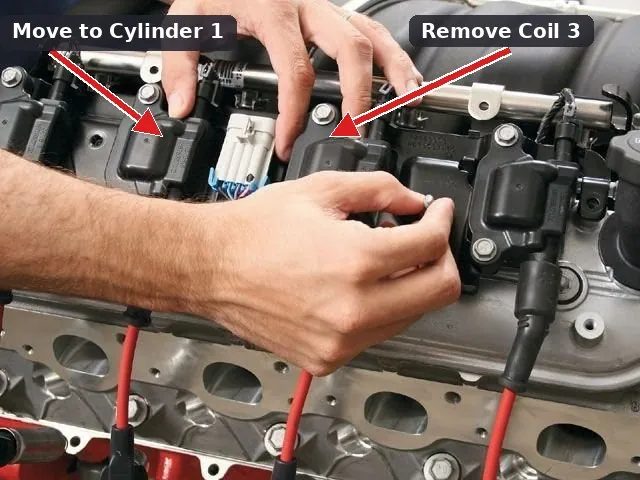
3. Consider a coil swap test. If your engine has individually removable, interchangeable coils and the service procedure permits it, swap the cylinder 3 coil with the coil from another identified cylinder, such as cylinder 2. Work with the ignition off and the engine cool. Keep track of which coil went where, and reconnect everything before checking for a returning fault.
4. Check whether the misfire follows the coil. After recording the original codes, follow the vehicle’s service instructions for clearing codes and checking for a return. If the misfire moves to the cylinder that received the former cylinder 3 coil—for example, a P0302 appears after a swap with cylinder 2—the coil is a strong suspect. If P0303 returns instead, keep investigating the cylinder rather than automatically buying a coil.
A swap is a diagnostic clue, not a reason to keep driving an unsafe car. Do not run a severe misfire simply to make a code return, and stop if the check engine light flashes. If the fault does not move, a technician can check the plug, injector, intake system, and compression using the procedures appropriate to the vehicle.
OBD-II Code P0303: Cylinder 3 Misfire Detected · www.go-parts.com
Why the Same Code Can Lead to Different Repairs
Two cars can show P0303 and need very different work. One may have a faulty ignition component that responds to a swap test; another may need an injector or compression test. That is why a code reader is useful but cannot replace a diagnosis. Ask what test supports the proposed repair and what the shop will do if the fault remains.
Manufacturer bulletins can help a shop investigate a known condition on a specific vehicle. For example, a Honda bulletin describes certain 2013–2017 Odyssey misfires in which piston-ring wear and sticking allow oil to foul spark plugs. Its repair procedure calls for diagnosis and, when necessary, further work; it does not mean every P0303 code has the same cause.
A bulletin also does not automatically establish coverage for your car. Give the dealer or repair shop your vehicle identification number and ask whether a bulletin applies and what coverage, if any, remains. Ford’s bulletin guidance notes that a dealer can help determine applicability and that warranty documents govern coverage.
P0303 Repair Costs: What to Ask Before Approving Work
There is no single P0303 repair price because the code does not identify the failed part. The cost depends on the diagnosis, the vehicle, the parts required, and the work needed to reach and repair them. A published P0303 guide recommends getting a written estimate for the specific repair rather than relying on an unsourced code-wide figure
Before you approve a repair, ask for an itemized estimate that separates diagnosis, parts, and labor. Ask which test identified the suspected component, whether the quote includes any additional work, and how the shop will verify the repair. If compression is low, ask what further testing is needed before approving internal engine work.
If you receive more than one estimate, compare the proposed work rather than only the final number. A quote to replace a suspected coil and a quote to investigate low compression address different findings. The useful question is whether the evidence supports the work—not whether a particular part is commonly associated with the code.After the repair, ask how the shop confirmed the result. Manufacturer diagnostic guidance includes checking whether the code returns under the relevant drive-cycle conditions. Verification helps distinguish a completed repair from a code that was merely cleared.
Conclusion
P0303 narrows the problem to cylinder 3, but it does not condemn a particular component. Record the codes, identify the correct cylinder, and use the results of appropriate tests to guide the repair. If the check engine light flashes, stop safely and get help before a misfire damages the catalytic converter.
