

Design Philosophy: Bold vs. Refined Aesthetics
At first glance, it’s clear that Hyundai and Kia have taken different design routes for their 2026 compact SUVs. Both are undeniably modern, yet their approaches create distinct visual identities.
Exterior Styling: Making a Statement
The 2026 Hyundai Tucson embraces an aerodynamic and minimalistic look. Its signature athletic exterior is characterized by an angular design language, giving it a very distinct and somewhat futuristic appearance. The integrated daytime running lights, which seamlessly blend into the grille on either side, are a prime example of this sleek integration.
The 2026 Hyundai Tucson showcases a sleek and angular exterior design.
In contrast, the 2026 Kia Sportage opts for a bolder, more expressive, and somewhat rugged aesthetic. While the 2026 update smoothed out some of its more controversial styling bits, it still maintains a unique style with its square design cues and futuristic elements. The much larger amber DRLs, a new addition for 2026, contribute to its assertive road presence. Some might even compare its boxier silhouette to that of the larger Kia Sorento or even the Hyundai Santa Fe.

The 2026 Kia Sportage presents a bold and expressive design with updated lighting.
The choice here is largely subjective. If you prefer a quietly confident, sleek, and tech-forward exterior, the Tucson might be your pick. If you're drawn to a more adventurous, robust, and visually striking vehicle, the Sportage aims to make a stronger visual statement.
Interior Ambience: Comfort and Technology
Stepping inside, both SUVs offer modern, well-appointed cabins, but with different philosophies regarding layout and material choices. Both models offer dual-screen setups with customizable digital driver displays and responsive center touchscreens, recognized as some of the best in their class.

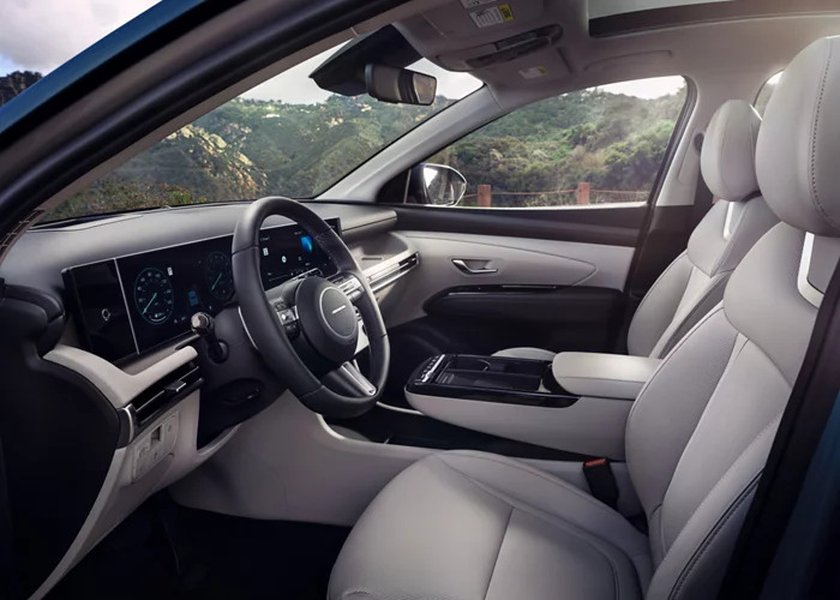
The 2026 Hyundai Tucson offers a refined and practical interior space.
The 2026 Hyundai Tucson typically features a more straight-to-the-point, premium interior. It feels airy and spacious, partly due to the gear shifter being relocated to the steering column, freeing up center console space. The mix of touch controls and conventional buttons and knobs is intuitive and straightforward. The Tucson focuses on practical style and comfortable space for passengers and cargo.
The 2026 Kia Sportage, on the other hand, often boasts a slightly more luxurious and sleek interior experience, especially with its 2026 updates. It tends to feature more soft-touch surfaces and a well-executed dashboard design. While also tech-forward, some users have noted that the Sportage's single row of touch-sensitive controls, which toggles between climate and audio functions, can be distracting while driving. However, features like available power folding mirrors and a traditional physical gear shift (on some trims) might appeal to others.

The 2026 Kia Sportage's interior emphasizes a sleek, modern, and driver-focused cockpit.
When it comes to comfort and space, both offer ample headroom and legroom in the front seats. The Tucson often has a slight edge in cargo room, especially behind the second row (38.7-41.2 cu.ft. vs. Sportage's 36.6-39.5 cu.ft.), and overall max cargo volume (74.8-80.3 cu.ft. vs. Sportage's 69.3-74.1 cu.ft.).
Performance and Powertrains: Shared Foundations, Distinct Driving Dynamics
Given their shared platform, the Tucson and Sportage naturally share many performance characteristics, including their core powertrains. Both are available with a range of options, including conventional gasoline, hybrid (HEV), and plug-in hybrid (PHEV) variants.
Engine Options and Acceleration
Both the 2026 Hyundai Tucson and Kia Sportage come standard with a capable Smartstream 2.5-liter direct-injected and multi-port-injected inline-four-cylinder engine, producing around 187 horsepower. When tested, the Tucson typically shows a slight advantage in acceleration, hitting 60 mph in approximately 8.8 seconds, compared to the Sportage's 9.1 seconds with the same engine.
For those seeking greater efficiency and power, both offer robust hybrid options:
- Hybrid (HEV): Both models offer a hybrid setup featuring a 1.6-liter turbocharged four-cylinder engine paired with an electric motor, delivering around 231 horsepower. These hybrid models often utilize a conventional 6-speed automatic transmission, which provides a more familiar and direct driving feel compared to e-CVTs found in many competitors.
- Plug-in Hybrid (PHEV): The PHEV variants increase the combined output further, with the Sportage PHEV producing approximately 268 horsepower and the Tucson PHEV reaching around 261 horsepower. These versions offer extended electric-only range, making them ideal for daily commuting without using gasoline.
Fuel Economy and Driving Experience
Fuel efficiency for the hybrid models is competitive, with both expecting around 35-38 mpg combined (6.5-7.0 L/100 km). While not class-leading, these figures represent a significant improvement over the standard gasoline engines.
In terms of driving feel, both SUVs offer a comfortable and composed ride. They absorb bumps well, and their cabins are generally quiet. Handling is secure and predictable, making them well-suited for daily driving and longer trips. However, some reviews suggest the Sportage, especially in certain trims, carries a bit more "personality" in its movements, hinting at a slightly sportier character, even if its base engine driving experience isn't overtly "sporty." The Tucson, conversely, is often described as feeling more refined and smooth.
Both models share the same turning radius, ensuring similar maneuverability in tight spaces. All-wheel drive (AWD) is available across various trims and is often standard on hybrid and PHEV variants, enhancing traction and control in diverse driving conditions.
Technology, Safety, and Value: Weighing the Offerings
Modern SUVs are packed with technology and safety features, and the 2026 Tucson and Sportage are no exception. They offer a comprehensive suite of advancements, though their packaging and standard inclusions can differ.
Infotainment and Connectivity
Both SUVs excel in infotainment, offering dual-screen setups with large, responsive displays. Wireless Apple CarPlay and Android Auto are standard on most, if not all, trims, providing seamless smartphone integration. The Tucson also features Bluelink+, Hyundai Pay, and Digital Key 2 on select trims. The Sportage for 2026 also offers available dual 12.3-inch displays and a 10.0-inch head-up display.
A notable difference highlighted by users is the control layout. The Tucson maintains a balance of touch controls with conventional buttons and knobs for common functions, which many find less distracting while driving. The Sportage, while sleek, has a single row of touch-sensitive controls that switch between climate and audio, which can require more attention to operate on the move.
Safety Features and Driver-Assistance
Both the Sportage and Tucson consistently earn high safety ratings. They come equipped with advanced driver-assistance systems (ADAS) to enhance confidence on the road.
| Feature Category | 2026 Hyundai Tucson | 2026 Kia Sportage |
|---|---|---|
| Design Philosophy | Sleek, aerodynamic, minimalistic, tech-focused | Bolder, expressive, slightly rugged, modern |
| Base Engine HP | 187 hp (2.5L I4) | 187 hp (2.5L I4) |
| Hybrid Powertrain | 231 hp (1.6L Turbo + Electric Motor) | 231 hp (1.6L Turbo + Electric Motor) |
| PHEV Powertrain | 261 hp | 268 hp |
| 0-60 mph (Gas) | ~8.8 seconds | ~9.1 seconds |
| Estimated Combined MPG (Hybrid) | 35-38 mpg | 35-38 mpg |
| Max Cargo Volume (Seats Folded) | 74.8 - 80.3 cu.ft. | 69.3 - 74.1 cu.ft. |
| Standard Infotainment | Large touchscreen, Wireless Apple CarPlay/Android Auto | Large touchscreen, Wireless Apple CarPlay/Android Auto |
| Control Layout | Mix of touch and physical buttons/knobs | Single row touch-sensitive for climate/audio |
| Starting MSRP | $31,050 - $35,099 (CAD) | $30,285 - $32,295 (CAD) |
| Key Safety Features | SmartSense (incl. Blind-Spot Collision Warning, Rear Cross-Traffic Assist) | Drive Wise (incl. Enhanced Collision-Avoidance Sensors, Lane-Keeping) |
The 2026 Sportage received safety upgrades including enhanced collision-avoidance sensors, lane-keeping improvements, forward collision avoidance assist with direct oncoming detection, Highway Driving Assist 2, updated parking sensors for all four sides, and Digital Key technology. The Tucson also offers SmartSense safety features, with Blind-Spot Collision Warning and Rear Cross-Traffic Collision-Avoidance Assist being among the standard features. Some comparisons suggest that certain advanced safety features might be standard on the Tucson at lower trims, while the Sportage might require an upgrade to include them.
Value Proposition and Pricing
When it comes to pricing, the Kia Sportage often holds a slight edge with a lower starting MSRP. For example, the 2026 Sportage starts around $30,285, while the Tucson begins at approximately $31,050. This trend can extend to certain features, with the Sportage sometimes offering more equipment for a lower price point compared to the Tucson.
However, "value" encompasses more than just the sticker price. Hyundai often includes perks like complimentary services for a set period (e.g., 3 years/36,000 miles), which can add to the overall ownership value. Kia is also known for its industry-leading warranty, providing long-term peace of mind. Both brands are recognized for strong reliability scores.
The decision on value may also come down to specific trim levels. The Tucson offers trims like SE, SEL, N Line, XRT, and Limited, alongside hybrid versions. The Sportage provides a wider array of options including LX, EX, X-Line, SX, SX Prestige, X-Pro, X-Pro Prestige, and multiple hybrid and plug-in hybrid variants, potentially offering more customization and specific feature bundles.
Real-World Considerations: Which One Fits Your Life?
Beyond the specs and features, how do these SUVs perform in everyday scenarios? Both are designed for practicality and comfort, but their subtle differences can impact your daily experience.
Urban Driving and Maneuverability
Both the Tucson and Sportage are efficient and easy to park, making them excellent choices for city dwellers. Their similar turning radii mean they maneuver comparably in tight spots. The light steering in the Sportage is often noted as ideal for city driving. The Tucson's "airy and spacious" feel, partly due to the repositioned gear shifter, could make it feel more agile in urban environments for some drivers.
Long-Distance Comfort and Utility
For longer journeys, ride comfort is paramount. Both SUVs offer impressive ride quality, absorbing bumps effectively and maintaining quiet cabins. The availability of hybrid powertrains in both models further enhances efficiency for extended trips. The Tucson's focus on comfortable passenger space and practical cargo solutions makes it a strong contender for family road trips.
Cargo space is a crucial factor for many SUV buyers. While very similar, the Tucson typically offers slightly more cargo volume both behind the second row and with the seats folded down. This marginal difference could be a deciding factor for those who frequently haul larger items or luggage.
The Verdict: Choosing Your Korean Companion
Ultimately, the 2026 Hyundai Tucson and Kia Sportage are both highly capable and compelling compact SUVs. Their shared engineering ensures a high baseline of quality, performance, and efficiency. The choice between them often boils down to personal preference in design aesthetic and interior ergonomics.
If you appreciate a sleek, more aerodynamic exterior with a refined and practical interior layout that prioritizes straightforward controls and maximum cargo space, the 2026 Hyundai Tucson is likely the better fit. It feels more tech-focused and offers a smoother, quieter ride experience.
If you are drawn to a bolder, more expressive exterior design, desire a slightly more luxurious and sleek interior ambience (even with the unique infotainment controls), and potentially value a lower starting price with a generous standard feature set, the 2026 Kia Sportage stands out. It's often perceived to carry more personality and offers a compelling overall value, backed by a strong warranty.
Many experts and owners agree that you can't go wrong with either vehicle. They both offer a strong blend of features, reliability, and modern design. Test driving both models is highly recommended to experience their subtle differences firsthand and determine which one truly resonates with your driving style and personal preferences.
As one Reddit user aptly put it when comparing these two: "The 2026 both SUV will be almost the same other than styling basically." This underscores that the visual and tactile experience is often the primary differentiator when mechanicals are so closely aligned.
This video provides an excellent visual comparison of the 2026 Kia Sportage and Hyundai Tucson, highlighting their shared platform and powertrains while emphasizing their distinct design elements and interior layouts. It helps visualize the differences discussed in this article, particularly the aesthetic choices and user interface nuances.
Frequently Asked Questions (FAQ)
Conclusion
The 2026 Hyundai Tucson and Kia Sportage exemplify the best of modern compact SUVs, offering compelling packages that blend style, technology, performance, and practicality. Their close relationship as corporate siblings means a shared foundation of engineering excellence, leading to reliable vehicles that are well-suited for a variety of needs. The choice between them ultimately hinges on personal aesthetic preference and a slight divergence in interior philosophy and feature packaging. By understanding these nuances, buyers can confidently select the SUV that aligns perfectly with their expectations and driving habits, securing a vehicle that is not just a mode of transport, but a genuine extension of their lifestyle
