

Highlights of the 2026 Tucson vs Sportage Showdown
- Design Philosophy: The Kia Sportage embraces a bold, futuristic, and angular aesthetic, while the Hyundai Tucson opts for a more refined, sculpted, and understated look.
- Interior Experience: While both offer modern, tech-forward cabins, the Sportage often presents a slightly more luxurious feel with increased soft-touch materials, whereas the Tucson feels more airy and spacious.
- Practicality & Value: The Tucson generally provides a touch more cargo space, while the Sportage can offer a more accessible starting price and a potentially longer powertrain warranty, making both compelling value propositions.
In the highly competitive compact SUV segment, two siblings from the same Korean automotive family consistently capture attention: the 2026 Hyundai Tucson and the 2026 Kia Sportage. Built on a shared engineering platform, these models offer a compelling blend of style, technology, and practicality. However, despite their common lineage, they present distinct personalities and subtle differences that can significantly influence a buyer's decision. This comprehensive comparison will dissect the nuances of the 2026 Tucson and Sportage, helping you determine which SUV best aligns with your preferences and lifestyle.
Both Hyundai and Kia have invested heavily in refining their offerings for the 2026 model year, ensuring that each vehicle is packed with advanced features, robust powertrains, and eye-catching designs. From their exterior aesthetics to their interior comfort, and from performance dynamics to cutting-edge technology, understanding these distinctions is crucial for making an informed choice in the thriving SUV market.
Design Philosophy Bold Expressions vs Refined Elegance
One of the most immediate and striking differences between the 2026 Hyundai Tucson and the 2026 Kia Sportage lies in their design philosophies. While both are undeniably modern, they appeal to different aesthetic sensibilities.
Exterior Styling A Visual Narrative
The 2026 Kia Sportage stands out with its bold, angular, and somewhat futuristic exterior. Its front fascia is defined by distinctive LED lighting elements and a prominent "tiger-nose" grille that gives it an assertive and aggressive road presence. The Sportage’s sculpted fenders and robust shoulder lines often contribute to a visually taller and more commanding stance, appealing to those who desire a sportier and more adventurous look.

The bold and angular exterior design of the 2026 Kia Sportage.
In contrast, the 2026 Hyundai Tucson embraces a more refined and sculpted design. Hyundai’s design language emphasizes smooth curves, geometric surface articulation, and a parametric jewel-pattern grille that integrates seamlessly with the daytime running lights. This approach results in a modern yet less polarizing aesthetic, offering a sleek and sophisticated appearance that tends to be more understated than the Sportage’s dramatic styling. The Tucson's profile often highlights clean lines and a premium feel.

The refined and sculpted exterior of the 2026 Hyundai Tucson.
Interior Ambiance Functionality Meets Luxury
Inside the cabin, both SUVs aim to provide a modern, tech-rich experience, but their approaches to ambiance and material use differ. The 2026 Kia Sportage often receives accolades for its interior quality, featuring more soft-touch materials, thoughtful design elements, and functional luxury. For the 2026 model year, some trims replace piano black trim with more durable faux wood accents in high-traffic areas, enhancing both aesthetics and longevity. The cabin often feels more driver-focused, with its layout and available upscale touches contributing to a luxurious atmosphere.

The driver-focused interior with premium materials in the 2026 Kia Sportage Hybrid.
The 2026 Hyundai Tucson also boasts a high-quality interior, frequently described as feeling more airy and spacious. This perception is partly due to design elements such as its steering-column-mounted gear shifter, which frees up valuable center console space. While the Sportage often edges out the Tucson in the sheer volume of soft surfaces and overall material polish, the Tucson's cabin is noted for its premium feel and enhanced by Hyundai's latest technological updates.
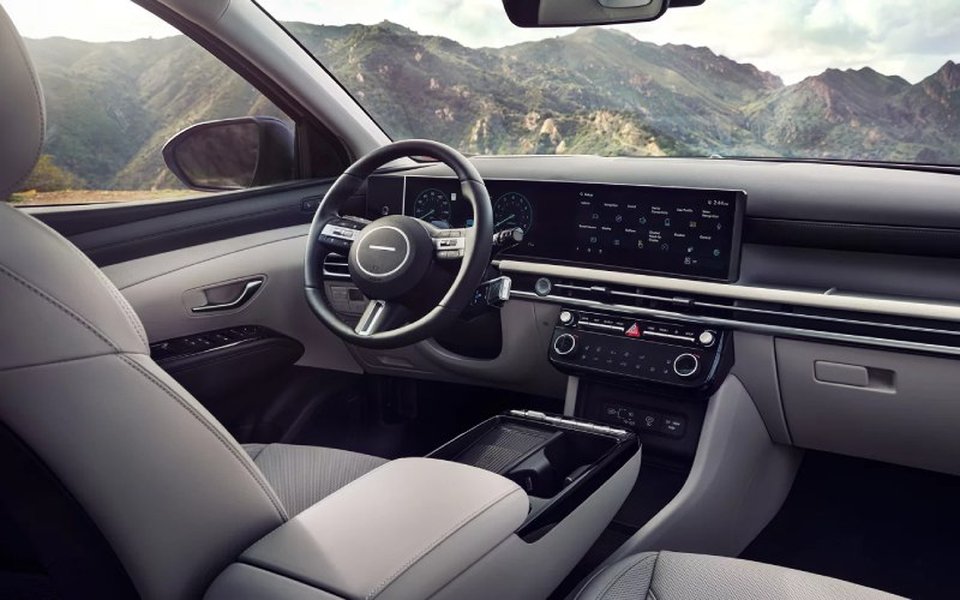
The spacious and tech-forward cabin of the 2026 Hyundai Tucson.
Technology and Features A Seamlessly Integrated Experience
Both the Tucson and Sportage are formidable contenders in terms of technology, offering advanced infotainment systems and comprehensive driver assistance features. The differentiation often lies in the execution and availability across trim levels.
Infotainment and Connectivit Dual Screens and Intuitive Controls
Both Hyundai and Kia excel in their infotainment systems, providing large dual-screen setups that include customizable digital driver displays and responsive central touchscreens. These systems are among the best in their class, offering sharp graphics and intuitive interfaces. Critically, both brands have wisely retained physical controls for essential functions like volume and climate, mitigating driver distraction often associated with purely touch-based systems.
- The 2026 Tucson typically features highly customizable 12.3-inch digital gauge clusters, allowing drivers to tailor the information displayed to their preferences. It also offers seamless integration with Google Built-in.
- The 2026 Sportage elevates the visual experience with an available dual panoramic display, combining two 12.3-inch screens into a single, cohesive unit. This setup provides an immersive feel, though its single row of touch-sensitive controls for climate and audio can require a slight learning curve.
Wireless Apple CarPlay® and Android Auto™ are standard or available on both models, ensuring easy smartphone integration. Options like premium audio systems (Bose in Tucson, Harman Kardon in Sportage), integrated navigation, and over-the-air (OTA) updates further enhance the user experience in both SUVs.
Driver Assistance and Convenience Enhancing Safety and Ease
Advanced Driver-Assistance Systems (ADAS) are a priority for both models, with a robust suite of safety and convenience features offered. These systems aim to provide a safer and less stressful driving experience.
- The 2026 Kia Sportage includes features such as Highway Driving Assist (HDA), Navigation-based Smart Cruise Control (NSCC), and an available Terrain Mode for AWD variants, enhancing capability in diverse conditions. Its Blind-Spot View Monitor, which displays a camera feed of the blind spot directly on the instrument cluster, is a notable advantage.
- The 2026 Hyundai Tucson offers a comparable suite of ADAS, including its HTRAC All-Wheel Drive system. A standout feature is Hyundai Digital Key 2.0, which allows a smartphone to act as a virtual car key, offering enhanced convenience and security. The Tucson also features remote smart parking assist, a convenience that some reviewers note is less commonly found on the Sportage. Hyundai's Bluelink+ connected services often come with a complimentary lifetime period, a potential benefit over some of Kia's offerings.
Both vehicles come standard with essential safety features such as Forward Collision-Avoidance Assist with pedestrian detection, Lane Keeping Assist, and Driver Attention Warning. Higher trims unlock advanced functionalities like 360-degree surround-view monitors and Blind-Spot Collision-Avoidance Assist.
Performance and Powertrains Shared Foundation, Distinct Feel
Given their shared platform, the 2026 Tucson and Sportage offer remarkably similar powertrain options, including gasoline, hybrid (HEV), and plug-in hybrid (PHEV) variants. However, subtle tuning differences can lead to a distinct feel behind the wheel.
Standard Engine Reliable Power for Daily Drives
Both models typically feature a standard 2.5-liter 4-cylinder gasoline engine, producing approximately 187 horsepower and 178 lb-ft of torque. This engine is paired with a conventional 8-speed automatic transmission, delivering a familiar and predictable driving experience. While the specifications are nearly identical, some subjective real-world driving observations suggest the Tucson might offer a slightly less engaging acceleration experience compared to the Sportage, though both provide adequate power for most daily driving scenarios.
Hybrid and Plug-in Hybrid Variants: Efficiency and Enhanced Performance
For buyers prioritizing fuel efficiency and boosted performance, both SUVs offer compelling hybrid and plug-in hybrid options:
- Hyundai Tucson Hybrid/PHEV: The hybrid variant delivers around 226-231 horsepower, offering a significant boost in power and improved fuel economy. The plug-in hybrid model can reach up to 268 horsepower, providing an even more potent and efficient driving experience, particularly with its electric-only range. The Tucson Hybrid generally achieves about 38 MPG combined.
- Kia Sportage Hybrid/PHEV: The Sportage Hybrid boasts a turbocharged engine, contributing to a total system output of approximately 227-231 horsepower. Its plug-in hybrid variant offers comparable power and efficiency. Notably, the Sportage Hybrid often achieves a slightly higher combined fuel economy rating, around 43 MPG, making it a segment leader in efficiency. The Sportage Hybrid also often delivers a quicker 0-60 mph time (around 7.7 seconds) compared to the Tucson Hybrid (around 8.5 seconds), offering a more spirited acceleration.
Both hybrid systems are praised for their seamless transitions between gasoline and electric power and their smooth, responsive delivery. The choice between them often comes down to specific efficiency targets and driving dynamics preferences.
All-Wheel Drive (AWD) and Off-Road Capability
Both vehicles offer capable All-Wheel Drive (AWD) systems. The Tucson features Hyundai's HTRAC AWD, known for its ability to intelligently distribute torque. The Sportage, especially in its X-Line and X-Pro trims, emphasizes enhanced off-road capability with available Multi-Terrain Mode settings (Snow, Mud, Sand) and specific suspension tuning. For those who frequently encounter challenging weather or light off-road conditions, the Sportage X-Pro might offer a slight edge in ruggedness.
Practicality and Space Maximizing Comfort and Utility
SUVs are often chosen for their practicality, encompassing passenger comfort, cargo volume, and overall usability. Both the Tucson and Sportage excel in these areas, though with subtle differences.
Cargo Volume: Every Cubic Foot Counts
When it comes to cargo space, the 2026 Hyundai Tucson generally offers a slight advantage:
- Hyundai Tucson: Offers approximately 38.7 to 41.2 cubic feet of cargo volume behind the rear seats and a generous 74.8 to 80.3 cubic feet with the rear seats folded down.
- Kia Sportage: Provides about 36.6 to 39.6 cubic feet behind the rear seats and 69.3 to 74.1 cubic feet with the rear seats folded. While the Sportage boasts "class-leading cargo space" in some marketing, the Tucson typically edges it out in raw numbers, especially for total volume.
This difference, though not vast, can be a deciding factor for individuals or families who regularly transport large items or require maximum storage capacity.
Passenger Comfort and Interior Roominess
Both SUVs are designed to comfortably accommodate five passengers, making them excellent choices for families. While the Tucson is often praised for its airy and open feel, contributing to a sense of greater spaciousness, the Sportage also delivers a comfortable and well-appointed cabin. Rear seat legroom is competitive in both models, with Kia often highlighting the Sportage's excellent rear legroom (around 41 inches, similar to the Tucson), making it a comfortable ride for adults in the back.
Both vehicles offer features like dual-zone automatic climate control, rear air vents, and comfortable seating with available heating and ventilation, ensuring passenger comfort regardless of the weather.
Driving Dynamics and Ride Quality Smooth Operator vs. Spirited Performer
Despite sharing a platform, the driving experiences of the Tucson and Sportage can feel distinct, reflecting their differing philosophies.
Ride Quality and Handling A Matter of Preference
- The 2026 Hyundai Tucson is frequently noted for providing a smoother and more comfortable ride. Its suspension tuning prioritizes daily commuting comfort and long-distance cruising, making it an excellent choice for those who value an easygoing and refined on-road demeanor.
- The 2026 Kia Sportage also offers a composed ride, but it often leans towards a slightly firmer suspension setup. This can translate to more engaging handling and a sportier feel, particularly on winding roads, though some might find it marginally less refined over rougher surfaces compared to the Tucson.
Ultimately, the "better" ride quality is subjective and depends on individual driving style and priorities.
Value and Ownership Experience Long-Term Peace of Mind
When assessing overall value, pricing, trim levels, reliability, and warranty coverage are critical factors. Both Hyundai and Kia are known for offering competitive packages.
Pricing and Trims: Accessible Options for Every Budget
Both SUVs offer a wide array of trim levels, catering to various budgets and feature preferences. While specific pricing can vary by region and optional packages, general trends emerge:
- The 2026 Hyundai Tucson typically starts at an MSRP around $28,350 to $31,000 for its base trims (like SE and SEL), with higher trims (N Line, XRT, Limited) and hybrid versions reaching into the high $30,000s or low $40,000s.
- The 2026 Kia Sportage often boasts a slightly more accessible starting price, beginning around $27,990 to $30,000 for its base LX and EX trims. Its extensive range of trims (SX, SX Prestige, X-Line, X-Pro) also reaches similar price points at the higher end. Some comparisons suggest the Sportage can offer more standard equipment for a lower price, particularly in its mid-level trims.
Reliability and Warranty Industry-Leading Coverage
Both Hyundai and Kia have established strong reputations for reliability, backed by some of the industry's most comprehensive warranty programs.
- The 2026 Hyundai Tucson typically receives strong predicted reliability ratings. For instance, J.D. Power often rates it highly, achieving scores like 85 out of 100, which is considered "Great."
- The 2026 Kia Sportage also boasts excellent reliability, with J.D. Power ratings often around 84 out of 100. Kia's industry-leading warranty, which often includes a 10-year/100,000-mile powertrain warranty, is a significant draw for buyers seeking long-term peace of mind and lower ownership costs.
This robust warranty coverage from both brands provides a compelling argument for their value proposition, offering buyers confidence in their investment.
Who Should Choose Which Korean SUV?
The decision between the 2026 Hyundai Tucson and 2026 Kia Sportage ultimately hinges on individual priorities and preferences. Both are excellent vehicles, but their subtle differences cater to distinct tastes.
Choose the 2026 Hyundai Tucson if:
- You prioritize a smoother, more comfortable, and refined ride for daily commuting and long journeys.
- You prefer a more understated, sculpted, and sleek exterior and interior design that offers a premium, airy feel.
- Maximum cargo space (especially with rear seats folded) is a key consideration for your needs.
- You appreciate highly customizable digital gauge clusters and a generally more conventional, user-friendly control layout.
- Features like Hyundai Digital Key 2.0 and remote smart parking assist appeal to your tech preferences.
- You are attracted by Hyundai's strong predicted reliability ratings and connected services like Bluelink+.
“The Tucson's interior feels more premium, while the Sportage offers deeper tech in certain trims. Both are great values on the same platform.”
Choose the 2026 Kia Sportage if:
- You are drawn to a bolder, more distinctive, and aggressive exterior and interior styling that makes a statement.
- You value a slightly more luxurious and driver-focused feel in the cabin materials and finish, with immersive dual panoramic displays.
- You seek a more engaging and spirited driving experience, perhaps with a slightly firmer ride.
- You desire enhanced off-road capability with specific X-Pro trims and features like Multi-Terrain Mode.
- You appreciate the efficiency lead of the Sportage Hybrid (e.g., 43 MPG combined) and quicker acceleration.
- Kia's industry-leading warranty, particularly its extensive powertrain coverage, provides you with significant peace of mind.
“If you want a sportier look with strong tech, go Sportage; if you want a quieter cabin and extra cargo space, Tucson is the better pick.”
Important Considerations for Buyers
While this comparison highlights key differences, remember that personal experience is paramount. Here are some crucial notes:
- The Test Drive is Essential: The "better" SUV is subjective. Always test drive both models back-to-back to experience their unique driving dynamics, interior environments, and overall feel.
- Trim Levels Matter Immensely: Features, pricing, and even certain design elements can vary significantly across different trim levels. Carefully compare the specific trims you are considering to ensure they meet your exact requirements and budget.
- Gas vs. Hybrid/PHEV: The choice of powertrain will dramatically impact performance, fuel economy, and upfront cost. Consider your driving habits, typical commute, and budget when making this decision.
- Shared Excellence: Both vehicles benefit from shared engineering, meaning they are fundamentally strong and reliable contenders. The differences are often about refinement, emphasis, and personal preference rather than outright capability shortcomings.
- Local Market Variations: Specifications, available features, and pricing can vary by region and country. Always verify details with local dealerships and official manufacturer websites.
This video offers a detailed review of the 2026 Kia Sportage Hybrid SX-Prestige, showcasing its features and driving experience. It is highly relevant for understanding the Sportage's practical application and advanced offerings.
Frequently Asked Questions
Conclusion A Choice of Nuance Between Two Outstanding SUVs
The 2026 Hyundai Tucson and 2026 Kia Sportage represent the pinnacle of compact SUV engineering from Korea, offering a compelling blend of design, technology, performance, and practicality. While they share a common foundation, their distinct personalities cater to different buyer profiles.
The Tucson appeals to those who value a refined, comfortable, and practical daily driver with a sleek, understated aesthetic and a slightly larger cargo capacity. Its airy interior and smooth ride make it an excellent companion for urban families and commuters. The Sportage, on the other hand, targets buyers who desire a bolder, more assertive design, a technologically immersive cabin with a touch of luxury, and potentially better hybrid fuel efficiency and a more engaging driving feel. Its X-Pro trims also offer a hint more rugged capability.
Ultimately, your choice will likely come down to which design language resonates more with you, which interior ambiance you prefer, and whether you prioritize a slightly smoother ride (Tucson) or a potentially more spirited drive with bolder tech (Sportage). Both vehicles offer outstanding value, robust warranties, and a plethora of features, ensuring that either option will serve as a highly capable and satisfying SUV for years to come. A thorough test drive of your preferred trims in both models is the best way to make your final decision.
