

Unraveling the mystery of your check engine light and pinpointing the exact issue with your downstream oxygen sensor.
Key Insights into the P0141 Code
- P0141 specifically targets the downstream O2 sensor's heater circuit: This is Bank 1, Sensor 2, located after the catalytic converter, distinguishing it from upstream sensor issues.
- Symptoms are often subtle, but critical for emissions and catalytic converter health: While drivability may not be severely affected, ignoring P0141 can lead to failed emissions tests and potential long-term damage.
- Diagnosis involves straightforward checks: From visual inspections and fuse checks to resistance tests with a multimeter, most common causes can be identified with basic tools.
That familiar glow of the "Check Engine" light can often bring a mix of anxiety and confusion. When your OBD-II scanner reveals a P0141 code, it's telling you something specific about your vehicle's exhaust system. This diagnostic trouble code (DTC) indicates a problem with the heater circuit of an oxygen sensor, but not just any oxygen sensor – it points to a particular one that plays a crucial role in your car's emission control system.
This comprehensive guide will demystify the P0141 code. We'll explain precisely what it means, how it differs from similar codes, its most common causes, and how you can perform simple diagnostic steps at home. We'll also cover the implications of this code for your vehicle's performance and provide realistic repair cost estimates. Our aim is to equip you with the knowledge to accurately diagnose and fix this issue, ensuring you address the right component and avoid unnecessary expenses.
Understanding the P0141 Code: What's the Engine Telling You?
The P0141 code, officially defined as "O2 Sensor Heater Circuit Malfunction (Bank 1, Sensor 2)," pinpoints an electrical problem within your vehicle's exhaust system. Let's break down each part of this technical description to make it clear:
The Role of Oxygen Sensors
Oxygen (O2) sensors are vital components that measure the amount of unburnt oxygen in your vehicle's exhaust gases. This information is then sent to the Engine Control Module (ECM) or Powertrain Control Module (PCM), which uses it to adjust the air-fuel mixture for optimal combustion. There are typically two types of O2 sensors: upstream (before the catalytic converter) and downstream (after the catalytic converter).
The Heater Circuit Explained
Modern O2 sensors require a specific operating temperature (often around 600°F or 315°C) to function accurately. When you first start your car, especially in colder weather, it takes time for the exhaust gases alone to heat the sensor to this temperature. This is where the built-in heater circuit comes in. It quickly warms the sensor, allowing it to provide precise readings to the ECM much faster. A "heater circuit malfunction" means this essential heating element, or its associated wiring, is not working as intended.
Bank 1, Sensor 2: Pinpointing the Location
- Bank 1: This refers to the side of the engine that contains cylinder #1. On inline engines (like a 4-cylinder), there's usually only one bank, so it's always Bank 1. On V-shaped engines (V6, V8, etc.), there will be two banks, Bank 1 and Bank 2.
- Sensor 2: This is the critical distinction for the P0141 code. "Sensor 2" denotes the downstream oxygen sensor, which is located after the catalytic converter in the exhaust system. Its primary function is to monitor the efficiency of the catalytic converter by comparing oxygen levels post-catalyst with those detected by the upstream sensor.
In essence, your car's computer has detected that the heater in the oxygen sensor positioned after the catalytic converter on the first engine bank is failing to warm up properly or at all within a specified timeframe.
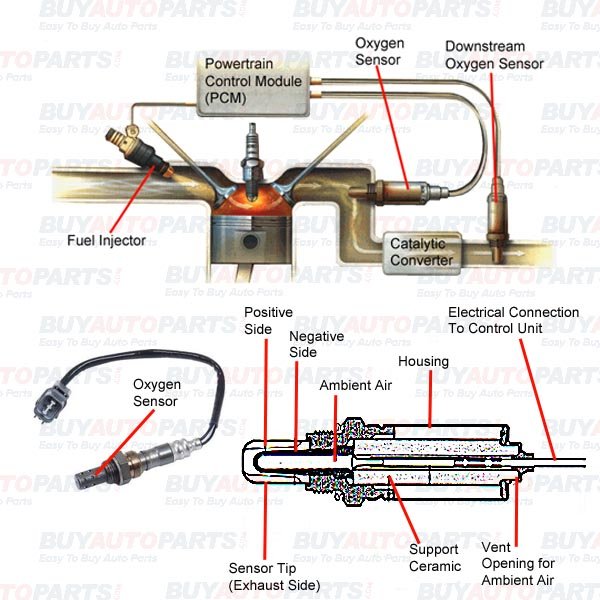
A typical oxygen sensor, showing its various components, including the heating element.
P0141 vs. P0135: A Crucial Distinction
It's common for car owners to confuse P0141 with other oxygen sensor codes, particularly P0135, which also relates to an O2 sensor heater circuit. Understanding the difference is paramount to diagnosing and repairing the correct part.
| Code | Sensor Location | Primary Function | Impact on Drivability/Fuel Trim |
|---|---|---|---|
| P0141 | Bank 1, Sensor 2 (Downstream, after catalytic converter) | Monitors catalytic converter efficiency and verifies emissions. | Minimal immediate impact on direct fuel trim; crucial for emissions compliance. |
| P0135 | Bank 1, Sensor 1 (Upstream, before catalytic converter) | Provides primary data for air-fuel mixture adjustment and engine performance. | Significant impact on fuel trim, potentially leading to noticeable drivability issues and reduced fuel economy. |
The distinction is vital: replacing the wrong sensor will not resolve your P0141 problem. Always ensure you are addressing the Bank 1, Sensor 2 for this specific code.
Recognizing the Symptoms of a P0141 Code
Unlike some engine codes that immediately cause noticeable performance issues, the P0141 code often presents with minimal symptoms beyond the illuminated "Check Engine" light. This is largely because the downstream O2 sensor's primary role is monitoring catalytic converter efficiency, not directly controlling the engine's air-fuel mixture.
The Most Common Indicators:
- Illuminated Check Engine Light (CEL): This is almost universally the first and often the only immediate symptom you'll encounter. The ECM triggers the CEL as soon as it detects the heater circuit malfunction.
- Failed Emissions Test: A P0141 code indicates a fault in a system designed to monitor emissions. Therefore, your vehicle will almost certainly fail any required emissions inspection.
- Slight Decrease in Fuel Economy: While not as dramatic as with an upstream sensor issue, a faulty heater can cause the downstream sensor to take longer to reach its operational temperature. During this period, the engine might run slightly richer than necessary, especially during cold starts, leading to a minor reduction in fuel efficiency (typically 10-15%).
- Other Oxygen Sensor-Related Codes: Sometimes, a P0141 might appear alongside other codes if the underlying issue is more complex or if the sensor is failing in multiple ways.
Important Note:
Many drivers report no noticeable changes in how their vehicle drives when the P0141 code appears. However, this does not mean the issue should be ignored. Promptly addressing it helps maintain your vehicle's emissions compliance and prevents potential long-term issues related to catalytic converter monitoring.
The Root Causes: Why the P0141 Code Appears
The P0141 code specifically points to an electrical issue within the O2 sensor's heater circuit. Understanding these common culprits will guide your diagnostic process.
Primary Causes:
- Failed O2 Sensor Heating Element: This is the most prevalent cause. Over time, the internal heating coil within the oxygen sensor can burn out or develop excessive resistance. This prevents the sensor from reaching its optimal operating temperature, triggering the code.
- Damaged Wiring: The wires connecting the O2 sensor to the vehicle's electrical system are exposed to harsh conditions (heat, vibrations, road debris). They can become frayed, corroded, or physically damaged, creating an open circuit (break) or a short circuit (improper connection to power or ground), interrupting power to the heater.
- Blown Fuse: Many oxygen sensor heater circuits are protected by a dedicated fuse. If this fuse blows, the heater element loses power, and the P0141 code will be set. Checking the fuse box should always be an early step in diagnosis.
- Corroded or Loose Electrical Connector: The electrical connector that plugs into the O2 sensor can suffer from corrosion on its pins or become loose due to vibrations. This can lead to intermittent or complete loss of power and ground to the heater circuit.
- Faulty Engine Control Module (ECM/PCM): While rare, a malfunctioning ECM/PCM can sometimes be the cause. It might incorrectly interpret sensor readings or fail to send proper voltage to the heater circuit. If you have multiple O2 sensor heater circuit codes (e.g., P0135 and P0141 simultaneously), and all other components test good, then a PCM issue might be suspected, but this is an uncommon scenario.
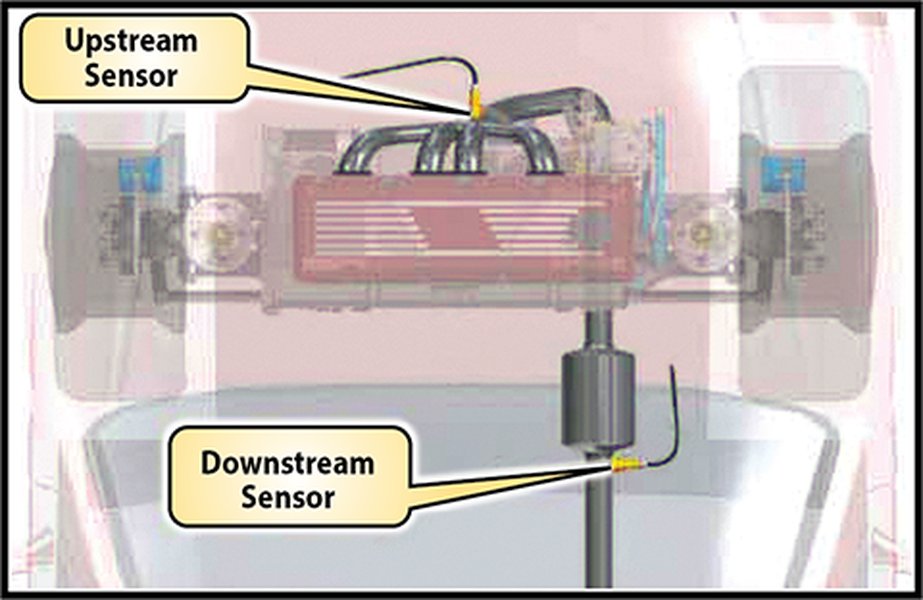
Diagram illustrating O2 sensor locations on a 4-cylinder transverse engine. P0141 refers to Bank 1, Sensor 2.
Diagnosing P0141: Step-by-Step at Home
You can perform several basic diagnostic checks to identify the cause of a P0141 code without specialized professional equipment. Always ensure the engine is cool before working on exhaust components.
Tools You Might Need:
- OBD-II scanner (to read and clear codes)
- Digital Multimeter (with ohms and volts settings)
- Vehicle service manual (for wiring diagrams, fuse locations, and O2 sensor specifications)
- Basic hand tools (wrenches, penetrating oil, wire strippers, electrical tape)
- Flashlight
Diagnostic Process:
1. Confirm the Code and Check for Others:
- Use your OBD-II scanner to confirm P0141 is the active code. Note if any other codes are present, as they might indicate a related or more complex issue.
- Clear the code and drive your vehicle through a few warm-up cycles. Sometimes, codes are temporary glitches. If P0141 returns, proceed with further diagnosis.
2. Locate Bank 1, Sensor 2:
- Identify the oxygen sensor located in the exhaust pipe after the catalytic converter, on the side of the engine containing cylinder #1.
- Refer to your vehicle's service manual or an online diagram for the exact location and identification of this specific sensor.
3. Visual Inspection of Wiring and Connector:
- Perform a thorough visual inspection of the O2 sensor's electrical connector and the wiring harness leading to it.
- Look for any obvious signs of damage: fraying, melted insulation, exposed wires, corrosion on the connector pins, or loose connections. The exhaust environment is harsh.
- If you find damaged wiring, repair it or replace the affected section. Clean any corrosion from the connector pins using electrical contact cleaner.
4. Check Relevant Fuses:
- Consult your owner's manual or service manual to locate the fuse box and identify fuses related to the oxygen sensor heater circuits. Some vehicles have a dedicated fuse for each O2 sensor's heater.
- Visually inspect the fuse for a broken wire. For a more reliable check, use your multimeter to test for continuity across the fuse. If it's blown, replace it with a fuse of the correct amperage.
5. Resistance Test of the O2 Sensor Heater Element:
This test determines if the heating element inside the sensor itself has failed.
- Disconnect the O2 sensor's electrical connector.
- Identify the two wires in the connector that belong to the heater circuit. On most 4-wire sensors, these are typically the two wires of the same color (often white or black). Your service manual will provide a pin-out diagram.
- Set your multimeter to the ohms (Ω) setting.
- Touch the multimeter probes to these two heater circuit pins on the O2 sensor side of the disconnected connector (not the vehicle harness side).
- Compare your reading to your vehicle's specifications, which are usually between 2-15 ohms at room temperature.
- If your multimeter reads "OL" (open circuit), "infinity," or a resistance significantly outside the specified range (e.g., extremely high resistance or zero resistance indicating a short), the heating element inside the sensor is likely faulty, and the sensor needs replacement.
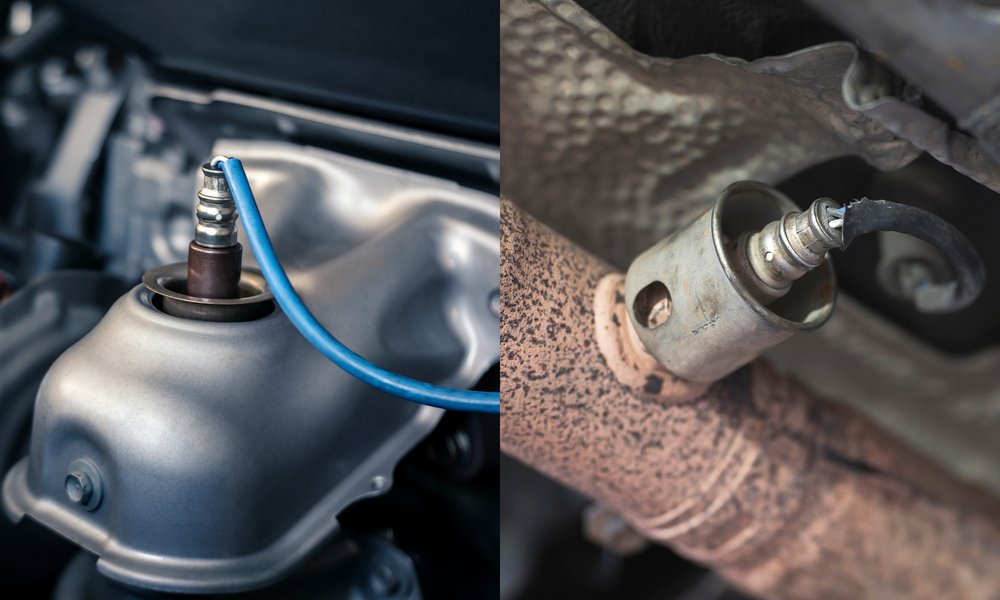
Upstream vs. Downstream O2 sensors, highlighting their placement relative to the catalytic converter.
6. Power and Ground Test at the Vehicle Connector:
This test verifies if the vehicle's wiring harness is supplying power and ground to the sensor heater.
- Ensure the O2 sensor's electrical connector is still disconnected from the sensor.
- Turn the ignition to the "ON" position (do not start the engine).
- Use your multimeter set to volts DC. Carefully back-probe the heater circuit wires on the vehicle's wiring harness side of the connector. Consult your vehicle's wiring diagram to identify the power and ground wires.
- You should measure approximately 12 volts (battery voltage) on the power wire and see continuity to ground on the ground wire.
- If there is no power or ground, the issue lies upstream in the vehicle's wiring, a relay, or potentially the ECM (though less common).
Safety First:
Always ensure your vehicle is safely supported on jack stands if you need to go underneath. Disconnect the battery's negative terminal before performing any electrical work, especially when checking fuses or disconnecting sensors, to prevent accidental shorts or damage to electrical components.
Severity and Implications of the P0141 Code
The P0141 code is generally considered a moderate severity issue. While it typically won't cause immediate catastrophic failure or leave you stranded, it should not be ignored indefinitely. Addressing it promptly is important for several reasons:
Key Considerations:
- Emissions Compliance: The downstream O2 sensor is crucial for monitoring catalytic converter efficiency, which is a key component of your vehicle's emissions system. With an active P0141 code, your vehicle will likely fail any emissions inspection.
- Fuel Economy: Although not a primary controller of fuel trim, a malfunctioning heater can delay the sensor's operation. This might lead to the engine running slightly richer for longer periods, especially during cold starts, resulting in a marginal decrease in fuel efficiency.
- Catalytic Converter Health: The downstream sensor's role is to confirm that the catalytic converter is performing its job effectively. If the sensor is not working correctly, it cannot accurately monitor the converter. While P0141 won't directly damage the catalytic converter, it means you're driving without critical monitoring, and a failing catalytic converter might go undetected, potentially leading to more expensive repairs down the line.
- Potential for Other Codes: If the underlying cause of the P0141 (e.g., wiring issues) is left unaddressed, it could potentially lead to other related electrical or sensor codes.
The main takeaway is that while your car might seem to drive fine, the P0141 code signals an inefficiency in a critical system. Addressing it ensures your vehicle remains environmentally compliant and its components are properly monitored.
Realistic Repair Costs for P0141
The cost to fix a P0141 code primarily involves replacing the faulty Bank 1, Sensor 2 oxygen sensor, or repairing its associated wiring. The overall cost varies based on whether you perform the repair yourself (DIY) or enlist a professional mechanic, as well as your vehicle's specific make and model.
DIY Repair Costs:
If you're comfortable with basic mechanical tasks, replacing an O2 sensor is often a straightforward process. The main expense will be the new sensor itself and potentially a specialized O2 sensor wrench.
- Replacement Oxygen Sensor: Prices typically range from $20 to $200. High-quality, OEM-equivalent sensors from reputable brands (like Denso, NTK) are recommended for reliability and proper function.
- Specialty Tools: An O2 sensor socket or crowfoot wrench, if you don't already own one, might cost an additional $15-$30.
Your total DIY cost will likely fall between $35 and $230.
Professional Repair Costs:
Hiring a certified mechanic will include both parts and labor. The labor time for replacing an O2 sensor is generally less than an hour, but shop rates vary by location.
- Parts (O2 Sensor): Similar to DIY, the sensor itself will cost $20 to $200.
- Labor: Mechanics typically charge between $50 to $200 for labor to replace an O2 sensor. This can depend on how easily accessible the sensor is.
- Diagnostic Fee: Many shops charge a diagnostic fee (ranging from $50 to $150), which might be waived if you proceed with the repair at their facility.
Total professional repair costs usually range from $200 to $500. For complex wiring issues or if the PCM is suspected, costs could be higher due to more extensive diagnostic time and specialized repairs.
Cost-Saving Tip:
Always obtain quotes from a few different reputable mechanics in your area. Ensure the quote explicitly states they are replacing "Bank 1, Sensor 2" to prevent any confusion or incorrect replacements.
Preventing Future O2 Sensor Heater Circuit Issues
While oxygen sensors are wear-and-tear items and their heater elements can fail over time, certain practices can help extend their lifespan and prevent premature failure.
Best Practices for Longevity:
- Regular Engine Maintenance: Keeping your engine in good tune—including timely spark plug replacements, clean air filters, and proper oil changes—ensures cleaner combustion. This reduces the burden on O2 sensors, as they are less exposed to harmful contaminants.
- Promptly Address Engine Misfires: Consistent engine misfires send unburnt fuel into the exhaust system, which can severely damage oxygen sensors and catalytic converters. Fix misfires as soon as they occur.
- Fix Oil Leaks: Oil leaks, particularly those that drip onto exhaust components or wiring, can contaminate and damage O2 sensors and their electrical connections. Address oil leaks promptly.
- Inspect Exhaust System for Leaks: Exhaust leaks before or near an O2 sensor can introduce outside air, leading to inaccurate readings and potentially affecting sensor operation. Ensure your exhaust system is sealed.
- Use Quality Fuel: Avoid low-quality or contaminated fuel, as it can lead to carbon buildup and deposits that foul O2 sensors, reducing their efficiency and lifespan.
- Careful Handling During Repairs: When working near exhaust components, be cautious not to damage O2 sensor wiring or connectors.
When to Seek Professional Expertise
While many P0141 issues are diagnosable and repairable by a capable DIY enthusiast, there are circumstances where professional assistance is recommended:
- You are uncomfortable working with vehicle exhaust systems or complex electrical components.
- The P0141 code persists even after you have replaced the sensor and thoroughly checked fuses and visible wiring. This could indicate a more intricate wiring issue (e.g., a break further upstream in the harness) or, in rare cases, a problem with the ECM/PCM.
- Multiple trouble codes are present alongside P0141. These additional codes might point to a larger, underlying issue that requires a more comprehensive diagnostic approach.
- You lack the necessary diagnostic tools, such as a quality multimeter or specialized O2 sensor removal tools.
- Wiring repairs are required in difficult-to-access areas or involve complex electrical troubleshooting.
Conclusion
The P0141 code, indicating an O2 Sensor Heater Circuit Malfunction for Bank 1, Sensor 2, is a common issue that triggers your Check Engine light. While it might not immediately impact your vehicle's drivability, it is a crucial signal that your emission control system isn't functioning optimally. This can lead to failed emissions tests and leaves the health of your catalytic converter unmonitored.
By understanding that this code specifically refers to the downstream O2 sensor's heater, performing basic visual and electrical checks, and knowing the realistic repair costs, you can confidently approach this problem. Whether you choose to tackle the repair yourself or seek professional help, you are now equipped with the knowledge to accurately diagnose and resolve the P0141 code, ensuring your vehicle runs efficiently and remains compliant with environmental standards.
