

From Myth to Manageable: Conquering the Psychological Hurdles of Electric Vehicle Ownership
In 2026, the question of whether EV range anxiety is a legitimate concern for electric vehicle owners has a clear answer: while it was once a significant barrier, it has largely evolved into an exaggerated fear for most drivers. Thanks to remarkable advancements in battery technology, the rapid expansion of charging infrastructure across the United States, and increasingly sophisticated trip planning tools, practical EV Range Anxiety Solutions are readily available. This article will provide comprehensive guidance on understanding and overcoming this anxiety, ensuring stress-free electric driving experiences for both new and seasoned EV enthusiasts.
Essential Insights for Confident EV Driving
- Modern EVs Offer Ample Range: Today's electric vehicles routinely provide 250-300+ miles on a single charge, far exceeding the average daily driving needs of most American commuters.
- Robust US Charging Network: The proliferation of fast-charging stations, including Tesla Superchargers and Electrify America, has made long-distance EV travel increasingly viable and predictable across the nation.
- Smart Planning and Battery Care are Key: Utilizing advanced trip planning apps and adopting effective battery management practices are crucial for maximizing real-world range and eliminating anxiety.
Is EV Range Anxiety Still a Real Problem in 2026?
The concept of range anxiety, defined as the fear of an electric vehicle running out of charge before reaching its destination or a charging station, has certainly diminished in its practical implications by 2026. What was once a tangible limitation for early EV adopters has largely transformed into a psychological hurdle. Early EV models, such as the first-generation Nissan Leaf with its modest 73-mile range, necessitated meticulous planning and were not ideal for extensive travel. However, the current generation of EVs tells a different story entirely.
Most new electric vehicles now deliver a real-world range between 250 and 300 miles on a single charge. Premium models from manufacturers like Tesla, Lucid, and Mercedes-Benz often surpass 400 miles. Considering that the average American drives approximately 40 miles per day, a modern EV can comfortably handle a week's worth of typical commuting without needing a recharge. This significant increase in range means that for daily driving and even many medium-distance trips, the practical concern of running out of power is minimal. The remaining anxiety often stems from unfamiliarity with EV capabilities and the evolving charging ecosystem, rather than an inherent limitation of the technology itself.
The Evolving US Charging Network: Why Range Anxiety Is Less Justified Today
One of the most pivotal developments in mitigating range anxiety is the remarkable growth and sophistication of the US charging network. The infrastructure has expanded at an unprecedented rate, making long-distance EV travel not just possible, but increasingly convenient. The Tesla Supercharger network, known for its reliability and extensive coverage, continues to lead, now with many stations opening to non-Tesla EVs. Other major networks like Electrify America, ChargePoint, and EVgo have also broadened their footprints dramatically, establishing a robust grid of charging options along major interstates and in urban centers.

An expansive map illustrating the dense network of EV charging stations across the United States.
These networks, coupled with user-friendly mobile applications like PlugShare and A Better Route Planner (ABRP), have revolutionized trip planning. These tools provide real-time information on charger availability, types, speeds, and even user reviews, allowing drivers to plan routes with confidence and account for variables like elevation changes and weather. The Biden administration's infrastructure investments have further accelerated this growth, ensuring that even more rural areas are gaining access to reliable charging stations. This expansion directly addresses the perceived lack of charging options, which was once a primary driver of range anxiety.
Real-World Range vs. Advertised Range: What to Expect from Popular US EVs
While manufacturers advertise impressive range figures, it is important for EV owners to understand that real-world range can vary based on numerous factors. Advertised EPA ratings are often achieved under ideal conditions, but everyday driving situations can produce different results. For instance, a Tesla Model 3 might be rated for 315 miles, but in real-world testing, it often achieves closer to 280-290 miles. Similarly, a Ford Mustang Mach-E rated at 270 miles might consistently deliver 230-250 miles, and a Chevrolet Bolt EV rated for 259 miles typically yields around 230-240 miles.
These variances are normal and should be factored into trip planning. Models like the Hyundai Ioniq 5/6 also show strong real-world performance, particularly in temperate weather, while the Rivian R1T/R1S, despite large battery packs, experiences a greater impact on range due to its higher aerodynamic drag and weight. Factors like driving speed (higher speeds significantly reduce efficiency), temperature (cold weather can reduce range by 20-30%), terrain (hilly routes consume more energy), and climate control usage all influence real-world range. Understanding these variables is key to setting realistic expectations and effectively managing your electric vehicle.
How to Overcome EV Range Anxiety: A Comprehensive Guide
Overcoming EV range anxiety primarily involves a shift in mindset, embracing strategic planning, and adopting smart battery management practices. It's about moving from a "refuel when empty" mentality to a "top up regularly" approach that aligns with the realities of EV ownership.
Top 10 Practical Battery Management Tips to Maximize EV Range
Effective battery management is paramount for extending your EV's range and ensuring a stress-free driving experience. Here are crucial tips:
- Maintain Optimal Charge Levels (20-80% Rule): For daily driving, aim to keep your battery charge between 20% and 80%. This practice reduces strain on the battery cells, minimizing degradation and extending overall battery life. Charging to 100% should be reserved for long trips.
- Prioritize Slow Charging: Whenever possible, use Level 1 (standard household outlet) or Level 2 (240V home charger) charging. These slower charging methods generate less heat, which is gentler on the battery compared to frequent DC fast charging.
- Precondition Your Battery and Cabin: Utilize your EV's scheduled departure feature or remote preconditioning. This warms or cools the battery and cabin while the vehicle is still plugged in, using grid power instead of battery energy. This significantly improves efficiency and range, especially in extreme temperatures.
- Utilize Regenerative Braking: Maximize your EV's regenerative braking settings. This feature converts kinetic energy generated during deceleration and braking back into usable electricity, recharging the battery and effectively extending your range.
- Drive Smoothly and Moderately: Aggressive acceleration and harsh braking consume significantly more energy. Maintaining steady speeds, avoiding rapid starts, and anticipating traffic flow can greatly improve your efficiency and extend your range. For highway driving, keeping speeds around 65-70 mph is ideal, as aerodynamic drag increases exponentially at higher speeds.
- Manage Climate Control Wisely: Heating and cooling the cabin are major energy consumers. In cold weather, use seat heaters and heated steering wheels (if available) instead of blasting cabin heat, as they are more energy-efficient. Preconditioning while plugged in also reduces the need for heavy climate control usage while driving.
- Monitor Tire Pressure: Underinflated tires increase rolling resistance, forcing the battery to work harder. Regularly check and maintain your tires at the manufacturer's recommended pressure for optimal efficiency and safety.
- Reduce Unnecessary Weight and Drag: Remove roof racks or cargo boxes when not in use, as they create aerodynamic drag that can reduce range by 5-15%. Avoid carrying excessive, unnecessary items in your vehicle.
- Keep Software Updated: EV manufacturers frequently release over-the-air software updates that improve battery management algorithms, charging efficiency, and overall vehicle performance. Ensure your EV's software is always current.
- Limit Frequent DC Fast Charging: While essential for road trips, frequent reliance on DC fast charging, especially in extreme temperatures, can contribute to faster battery degradation. Use Level 2 charging for daily needs and save fast charging for when it's truly necessary.

A clear roadmap demonstrating strategic charging stops during an EV road trip.
How to Plan Long Trips with an EV Without Range Anxiety
Planning an EV road trip requires a slightly different approach than with gasoline vehicles, but with modern tools, it's straightforward and largely stress-free. This step-by-step guide will help you plan effectively:
- Understand Your Vehicle's Real-World Range: Based on your driving habits and typical conditions, establish a conservative real-world range estimate. If your EV is rated for 300 miles, plan for perhaps 240-260 miles between charges to create a buffer.
- Utilize Dedicated EV Trip Planning Apps: Apps like A Better Route Planner (ABRP) and PlugShare are indispensable. ABRP accounts for your specific EV model, current battery state of charge (SoC), desired charging stops, elevation changes, and even weather conditions to generate optimized routes with charging recommendations. PlugShare provides real-time information on charger availability, pricing, and functionality, along with user reviews.
- Identify Charging Stations Strategically: Use your chosen app to locate DC fast-charging stations along your planned route. Look for locations with multiple charging stalls to ensure availability and check recent user check-ins for reliability.
- Plan Charging Stops Around Activities: Integrate charging stops with natural breaks like meals, sightseeing, or restroom breaks. Many DC fast chargers can add 150-200 miles of range in just 15-20 minutes, allowing you to efficiently combine charging with other activities.
- Embrace the 80% Charging Rule for Road Trips: For faster overall travel, it's often more efficient to charge your battery to approximately 80% at DC fast chargers rather than waiting for 100%. As the battery approaches full capacity, charging speeds significantly taper off. Two shorter charges to 80% are usually quicker than one longer charge to 100%.
- Have Backup Options: Always identify at least one alternative charging location near each planned stop. This provides peace of mind in case a charger is occupied, out of service, or experiences slower-than-expected speeds.
- Monitor Consumption and Adjust: During your trip, keep an eye on your real-time energy consumption. If you encounter headwinds, extreme weather, or higher-than-anticipated elevation, reducing your speed by 5-10 mph can significantly extend your range and help you comfortably reach the next charging stop.
- Precondition Before Departure and Before Charging: Schedule your EV to precondition while plugged in before starting your journey. For subsequent fast-charging stops, some EVs allow you to pre-warm the battery before arrival, optimizing charging speeds, especially in colder climates.
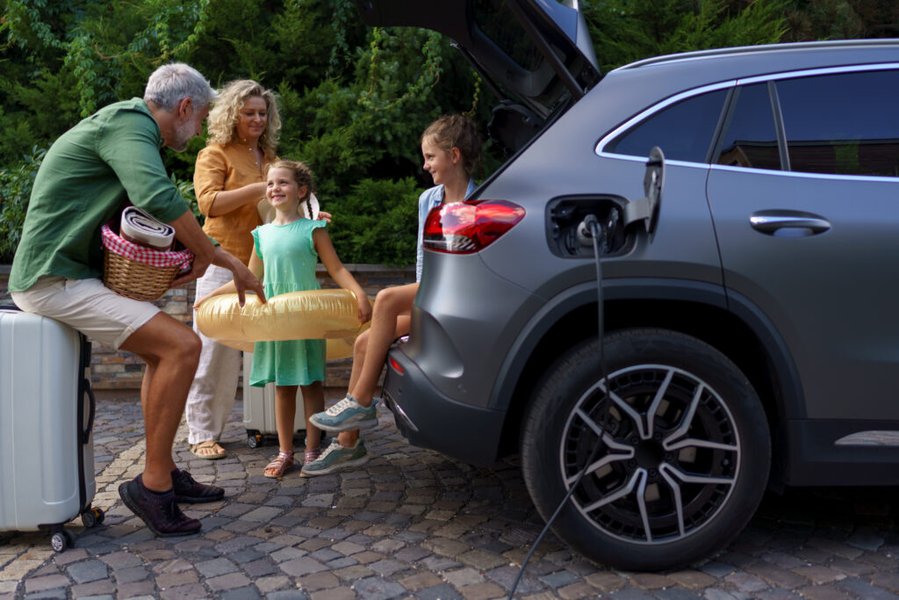
An electric vehicle charging at a station, symbolizing the ease of topping up on a long journey.
How Driving Speed, Temperature, and Cargo Weight Affect Real-World Range
Understanding the external factors that influence your EV's real-world range is crucial for effective trip planning and managing anxiety:
- Speed: Aerodynamic drag is the primary factor affecting range at higher speeds. Drag increases exponentially with speed, meaning driving at 75 mph consumes significantly more energy than driving at 65 mph. A consistent speed of 60-65 mph is often the sweet spot for maximizing highway range. Expect a 15-20% reduction in range when consistently driving at 75 mph compared to 65 mph.
- Temperature: Both extreme cold and heat impact battery performance. Cold weather (below 40°F) is the more significant factor, as lithium-ion batteries are less efficient and a substantial amount of energy is diverted to heating the battery pack and cabin. Expect a 20-30% range reduction in freezing conditions. While less severe, very hot temperatures can also impact efficiency and battery health over time. Preconditioning helps mitigate these effects.
- Cargo Weight and Aerodynamic Drag: Just like gasoline vehicles, heavier loads require more energy to move. While less pronounced than speed or temperature, a fully loaded EV with passengers and luggage will have a shorter range. Roof racks, cargo boxes, or even open windows at highway speeds also create additional aerodynamic drag, reducing efficiency and range by 5-15% depending on the specific setup and speed.
Preconditioning: Your Hidden Range Booster and Fast-Charging Accelerator
Preconditioning is one of the most valuable, yet often underutilized, features for maximizing range and optimizing charging speeds. This process involves bringing the battery and cabin to an optimal temperature before departure or before arriving at a fast charger, ideally while the vehicle is still plugged in.
Most modern EVs, including models like the Tesla Model Y, Ford Mustang Mach-E, Hyundai Ioniq, Rivian, and Chevrolet Bolt EUV, allow you to schedule departure times or remotely activate preconditioning via their mobile apps or in-car navigation systems. By doing so, the vehicle uses grid power to heat or cool the battery to its most efficient operating temperature (typically around 70-75°F) and the cabin to your desired comfort level. This means you start your journey with maximum available range, as no battery energy is expended for initial climate control or battery conditioning.
In cold weather, preconditioning can improve your initial range by 15-20% compared to starting with a cold battery. When navigating to a DC fast charger, many EVs will automatically begin battery preconditioning, which is crucial for achieving the fastest possible charging speeds upon arrival. A cold battery charges much slower, so pre-warming it ensures you spend less time waiting at the charging station.
The 80 Percent Charging Rule: Why Stopping Sooner is Faster on Road Trips
For efficient long-distance EV travel, the "80 percent rule" is a fundamental principle. This rule advises that on road trips, it's generally more efficient to charge your EV's battery to around 80% capacity at a DC fast charger, rather than waiting for a full 100% charge.
The reasoning is rooted in the physics of lithium-ion batteries. EV batteries charge fastest when their state of charge (SoC) is lower, typically between 10-80%. As the battery approaches full capacity (above 80%), the charging rate significantly tapers off to protect the battery and prevent overheating. This "tapering" means that the final 20% of a charge (from 80% to 100%) can often take as long, or even longer, than the initial 70% (from 10% to 80%).
By stopping at 80% and driving to the next charger, you minimize your wait time at each station. For example, you might add 150 miles of range in 15-20 minutes charging from 10% to 80%, but it could take an additional 30 minutes to add the final 50 miles to reach 100%. In that same 30 minutes, you could have already driven to the next charging stop and begun another rapid charge. This strategy, often referred to as "leapfrogging," significantly reduces total travel time on long trips and is a cornerstone of efficient EV road tripping.
Tips for Finding Charging Stations Along Any US Route
Locating reliable charging stations across the US is easier than ever, thanks to a robust infrastructure and powerful digital tools:
- Utilize Multiple Apps: While your EV's native navigation system (e.g., Tesla's Supercharger network integration) is excellent, supplement it with third-party apps. PlugShare is a community-driven app that provides real-time data, user reviews, photos, and availability for virtually all public charging stations, including Level 2 and DC fast chargers. A Better Route Planner (ABRP) is invaluable for comprehensive trip planning.
- Check Network Reliability: Some charging networks offer greater reliability than others. Tesla Superchargers are widely regarded as the most dependable, followed by networks like Electrify America and EVgo. Always check recent user check-ins on PlugShare to gauge the current status and functionality of specific stations.
- Look for Charging Clusters: Many popular locations, such as shopping centers, rest stops, and entertainment complexes, now host multiple charging networks in close proximity. This provides redundancy and more options if a preferred charger is occupied or not functioning.
- Consider Destination Charging: Many hotels, restaurants, and attractions now offer Level 2 charging. Planning overnight stays or daytime activities around these destinations allows you to combine charging with other activities, making the process seamless.
- Carry Multiple Memberships/Apps: While many newer chargers support contactless credit card payments, having accounts or apps for major networks like ChargePoint and Electrify America can streamline the charging process and sometimes offer better rates.
Beat Range Anxiety: Electric Car Tips for New and Experienced Drivers
Whether you're a new EV owner just getting accustomed to electric driving or an experienced driver looking to optimize long-distance travel, overcoming range anxiety involves a combination of practical strategies and a confident mindset. For new owners, starting with shorter, familiar trips to build confidence in your vehicle's range and the charging process is highly recommended. As you gain experience, the psychological aspect of range anxiety naturally diminishes.
Experienced drivers can focus on fine-tuning their habits, such as mastering dynamic route adjustments based on real-time traffic and weather, and optimizing their preconditioning and charging strategies. Regardless of experience level, understanding your EV's capabilities, regularly using regenerative braking, and maintaining efficient driving habits are universally beneficial. EVs like the Ford Mustang Mach-E, with features like adaptive cruise control, can help maintain optimal speeds and further reduce driving stress. The goal is to transform range anxiety into a sense of preparedness and enjoyment on every journey.
Frequently Asked Questions About EV Range Anxiety
Conclusion: Embracing the Electric Future with Confidence
In conclusion, while EV range anxiety may linger as a psychological echo of past limitations, it is demonstrably no longer a practical impediment to electric vehicle ownership in 2026. The convergence of significantly increased battery ranges, a rapidly expanding and increasingly reliable US charging infrastructure, and powerful digital planning tools has effectively provided comprehensive EV Range Anxiety Solutions. By embracing strategic trip planning, adopting smart battery management practices, and understanding the real-world factors that influence range, both new and experienced EV drivers can confidently embark on any journey, transforming apprehension into an enjoyable and efficient electric driving experience. The future of transportation is electric, and with proper knowledge and preparation, it is also worry-free.
Recommended Further Reading
- How to Check Tesla Battery Health (State of Health Guide)
- Top 5 Causes of EV Battery Degradation and How to Avoid Them
- Unleash Your Nissan Leaf's True Potential: The Ultimate Battery Upgrade Guide
- Unraveling the Mystery of EV Battery Isolation Faults (Code P0AA6)
