

Your comprehensive guide to extending your electric car's battery lifespan beyond expectations.
- Shallow Cycling is Your EV's Best Friend: Frequent, partial charges (20-80% State of Charge) significantly extend battery life by reducing stress and degradation compared to deep cycles.
- Temperature Management is Crucial: Extreme heat accelerates battery aging, while moderate temperatures, often maintained by advanced thermal management systems, preserve cycle life.
- LFP Batteries Lead in Cycle Life: Lithium Iron Phosphate (LFP) chemistry offers superior cycle counts (3,000+), making it a durable choice, especially when compared to NMC/NCA types.
The lifespan of an Electric Vehicle (EV) battery is a paramount concern for both prospective and current owners. Understanding EV battery cycle life is fundamental to maximizing your vehicle's performance, range, and overall value for well over a decade. Modern lithium-ion batteries are engineered for remarkable durability, and with informed practices, they can easily outlast the typical ownership period of a gasoline car. This guide will demystify EV battery cycles, explain the critical difference between shallow and deep charging, detail how various factors influence longevity, and provide actionable tips for extending your EV battery's life.
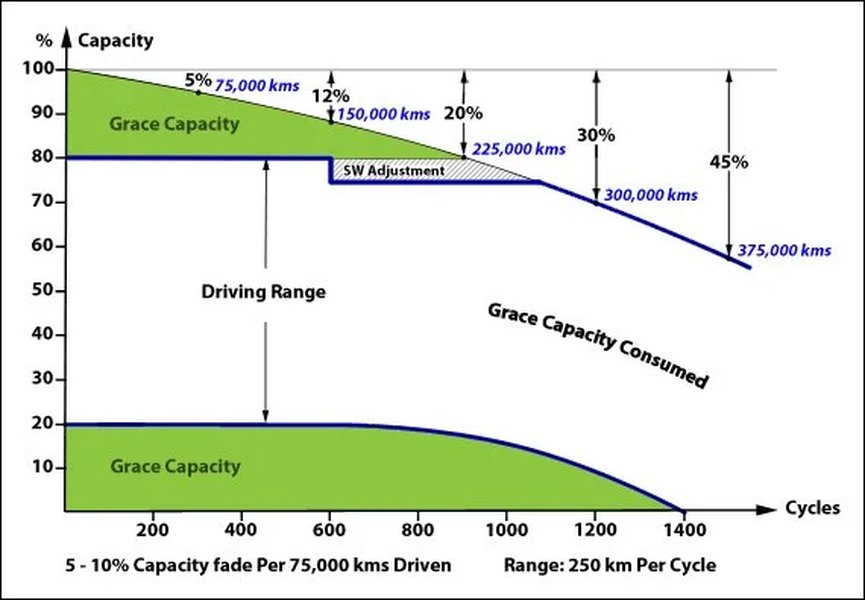
Illustration of EV battery cycle life showing shallow vs deep cycles over time, highlighting less stress with shallow discharges.
Decoding the EV Battery Cycle: What Does It Really Mean?
At its core, an EV battery cycle represents a full discharge and recharge of the battery's total capacity. However, in real-world usage, this isn't usually a direct 0% to 100% scenario. Instead, engineers and Battery Management Systems (BMS) track "equivalent full cycles." For example, if you deplete 50% of your battery's charge and then recharge it, and repeat this process the next day, those two 50% discharges combine to form one equivalent full cycle.
This nuanced understanding is crucial because it highlights that simply plugging in your EV daily doesn't necessarily equate to completing a full cycle. The total energy throughput is what truly matters for assessing battery wear.
Understanding Key Terminology: SOC, DOD, and Cycle Count
- State of Charge (SOC): This refers to the current charge level of your battery, typically expressed as a percentage (e.g., 60% SOC means the battery is 60% full).
- Depth of Discharge (DOD): This measures how much of the battery's capacity you utilize between charges. If you use 40% of the battery before recharging, that's a 40% DOD. Lower DOD is generally more beneficial for longevity.
- Cycle Count: This is the cumulative number of equivalent full cycles the battery has undergone throughout its operational life.
Shallow vs. Deep Charge Cycles: The Longevity Advantage of Less
One of the most impactful factors influencing EV battery cycle life is the depth of discharge. Research consistently demonstrates that employing shallow cycles significantly extends battery lifespan compared to repeatedly performing deep cycles. This is a critical concept for any EV owner aiming to maximize their battery's health.
Why Shallow Cycles Reign Supreme
Lithium-ion batteries prefer to operate within a moderate range of their State of Charge (typically 20-80%). When a battery is consistently discharged to very low levels or charged to 100% and held there for extended periods, it experiences increased stress on its internal chemistry. This stress accelerates various degradation mechanisms, such as lithium plating on the anode and structural stress on electrode materials, leading to a faster loss of capacity.
Conversely, shallow cycles keep the battery cells within a more stable voltage range, limiting extreme chemical reactions and thermal fluctuations. For instance, charging your EV from 40% to 80% (a 40% DOD) and repeating that process is far less strenuous on the battery than a single discharge from 100% to 0% and back. This gentle treatment can effectively double or even triple the battery's effective cycle life.
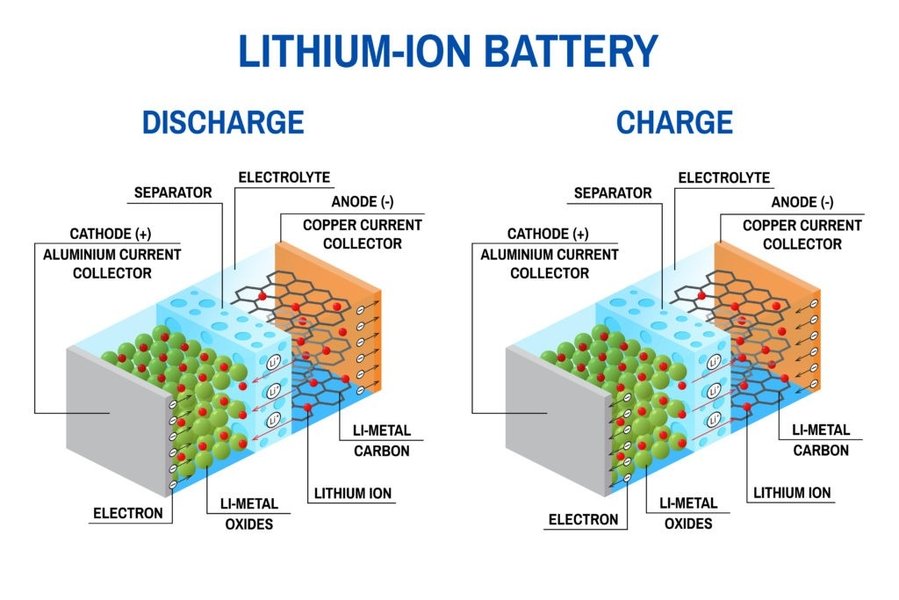
Diagram illustrating the difference between deep and shallow discharge cycles and their impact on battery health.
How Many Cycles Does an EV Battery Last? Unpacking Lifespan Estimates
The total number of cycles an EV battery can endure before its capacity drops to a significant threshold (typically 70-80% of its original capacity) varies based on several factors, including battery chemistry, manufacturing quality, and user habits. Generally, modern EV batteries are designed to withstand thousands of cycles.
Battery Chemistry and Cycle Performance
Different lithium-ion chemistries offer distinct trade-offs in terms of energy density, power delivery, cost, and crucially, lithium ion battery cycle life explained by their inherent characteristics. Here's a comparison of the most common types found in U.S. EVs:
| Chemistry | Typical Cycle Life (to 80% capacity) | Key Characteristics | Common Examples in U.S. EVs |
|---|---|---|---|
| NMC (Nickel Manganese Cobalt) | 1,000 - 1,500 cycles | High energy density, balanced performance, good range | Chevrolet Bolt, Ford Mustang Mach-E, Hyundai Ioniq 5/6, some Tesla models |
| LFP (Lithium Iron Phosphate) | 3,000 - 5,000+ cycles | Excellent longevity, high stability, lower cost, safer | Tesla Model 3/Y Standard Range, some Ford models |
| NCA (Nickel Cobalt Aluminum) | 1,000 - 2,000 cycles | Very high energy density, performance-oriented | Some Tesla Long Range models, Rivian R1T/R1S |
As the table illustrates, LFP batteries typically boast a significantly higher cycle life, making them increasingly popular for vehicles where longevity and stability are prioritized, even if they historically offered slightly lower energy density. Considering the average American drives about 13,500 miles annually, and with modern EVs offering ample range (e.g., 250 miles), these cycle counts translate into many years of reliable use—often well over 10 to 15 years.
The Environmental Factor: How Temperature Impacts EV Battery Cycle Life
Temperature plays a profound role in the degradation rate of lithium-ion batteries. Both extreme heat and cold can affect battery health, but heat is generally the more detrimental factor for long-term longevity. Modern EVs sold in the U.S. feature sophisticated thermal management systems to mitigate these effects, but owner awareness remains vital.
Hot Climates: Accelerating Degradation
High temperatures accelerate the chemical reactions within the battery cells that lead to degradation. This includes the accelerated growth of the solid electrolyte interphase (SEI) layer and increased electrolyte decomposition. In regions with consistently high temperatures, like Arizona or parts of Texas and Florida, EVs can experience faster capacity loss. Parking in shaded areas, utilizing garage parking, and pre-conditioning the cabin while plugged in (allowing the battery's thermal system to work using grid power) can significantly reduce this thermal stress.
Cold Climates: Range Reduction, Less Permanent Damage
While cold temperatures (such as those experienced in Minnesota or Colorado winters) can temporarily reduce an EV's range and charging speed, they are generally less damaging to the battery's long-term health than extreme heat. Cold slows down chemical reactions, which can actually preserve the battery's chemical structure. However, attempting to DC fast charge a very cold battery without preconditioning can sometimes lead to uneven lithium plating, so using the EV's preconditioning features before charging in winter is a recommended practice.
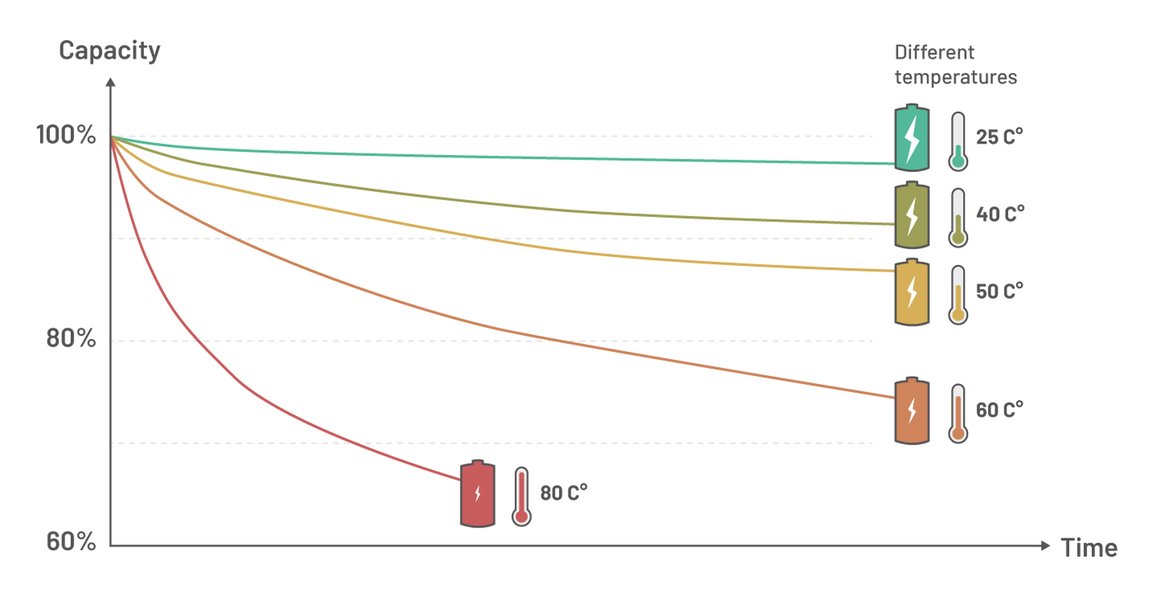
Infographic detailing the impact of temperature on battery aging, showing how extremes accelerate degradation.
Charging Habits: Your Influence on EV Battery Charge Cycles Guide 2026
Your daily charging routines and driving style directly influence your EV battery's health and its ability to achieve a 10+ year lifespan. Avoiding certain habits can significantly prolong your battery's cycle life and overall performance.
The Perils of Daily 100% Charging
Regularly charging your EV to 100% places undue stress on the lithium-ion cells, particularly for NMC and NCA chemistries. At very high states of charge, the cell voltage is elevated, accelerating internal degradation mechanisms. Most manufacturers, including popular U.S. brands like Tesla and Ford, recommend limiting daily charging to 80-90% for typical use. Only charge to 100% when you genuinely need the full range for a long road trip.
Frequent DC Fast Charging: A Double-Edged Sword
While convenient for long-distance travel across the U.S. charging infrastructure, frequent use of DC fast chargers (Level 3) generates more heat and stress on the battery than slower Level 1 or Level 2 charging. This increased thermal and electrochemical stress can accelerate degradation. It's best to reserve DC fast charging for when you need to cover long distances quickly, and rely on Level 2 home or workplace charging for daily top-ups. Modern EVs with advanced thermal management do mitigate some of this impact, but moderation is still key.
Avoiding Extreme States of Charge for Extended Periods
Leaving your EV parked for long durations at either very high (above 90%) or very low (below 20%) states of charge can accelerate calendar aging. If storing your EV for an extended period, manufacturers typically recommend maintaining a charge level between 50-60%.
Real-World EV Battery Lifespan Cycles: Tesla, Nissan, and Other Popular Models
Real-world data from thousands of EVs on American roads provides valuable insights into actual battery longevity, often exceeding initial expectations and warranty periods.
- Tesla (Model 3, Model S, Model Y): Renowned for advanced battery management and thermal control, many Tesla batteries demonstrate remarkable longevity. Real-world data shows many nickel-based Tesla batteries retaining 80-90% capacity after 150,000-200,000+ miles. LFP variants, increasingly found in Standard Range models, are projected for even longer lifespans, consistent with 2,000-3,000+ cycles.
- Nissan Leaf: Earlier generations of the Nissan Leaf, which often lacked active thermal management for their batteries, sometimes experienced more pronounced degradation, especially in hot climates. However, newer Leaf models have improved chemistries and passive cooling, showing better retention. Many Leaf batteries still perform well beyond 100,000 miles.
- Chevrolet Bolt: Equipped with liquid cooling, the Chevrolet Bolt EV's NMC battery typically shows a gradual and linear capacity loss, aligning with expectations for nickel-based chemistries. Owners frequently report good battery health even after 100,000 miles.
- Ford Mustang Mach-E, Hyundai Ioniq 5/6, Rivian: These newer models benefit from state-of-the-art liquid thermal management systems and sophisticated BMS, contributing to promising early real-world degradation data that suggests long and healthy battery lives.
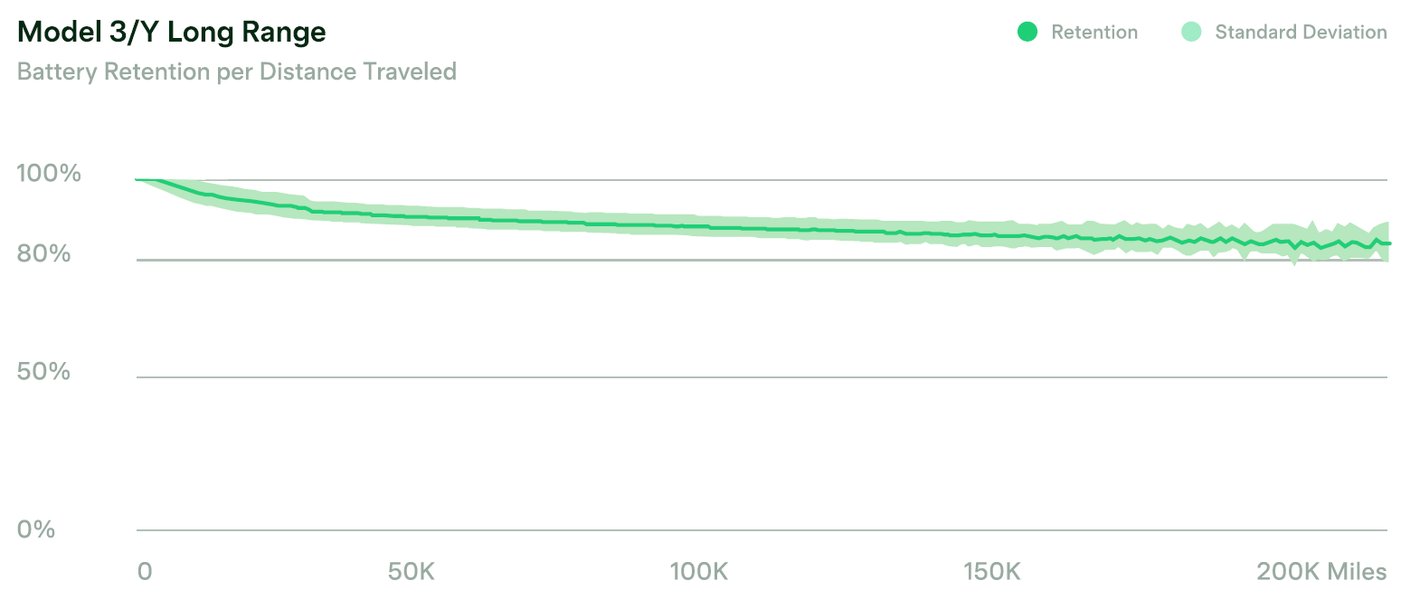
Graph showing average Tesla Model 3 and Model Y battery capacity degradation over mileage.
Calendar Aging vs. Cycle Aging: Which Affects EVs More?
Battery degradation isn't solely caused by driving and charging; time itself also contributes. Two primary mechanisms drive battery aging:
- Cycle Aging (Cyclic Degradation): This refers to the degradation that occurs as the battery undergoes charge and discharge cycles. It's influenced by the depth of discharge, charge/discharge rates (C-rates), and temperature during these cycles.
- Calendar Aging (Calendaric Degradation): This is the degradation that happens over time, regardless of whether the battery is being used. Factors like ambient temperature and the battery's average State of Charge (SOC) during storage significantly influence calendar aging.
For most private EV owners in the U.S. who do not routinely deep-cycle their batteries or drive exceptionally high mileages, calendar aging often has a greater impact than cycle aging. This means that even if an EV isn't driven extensively, its battery will still gradually lose some capacity over the years due to inherent chemical changes over time. However, for high-mileage users like rideshare drivers or delivery services, cycle aging becomes the dominant factor.
Practical Tips to Maximize EV Battery Cycle Life for 10+ Years
Based on current research, manufacturer recommendations, and real-world data, adopting these practices can significantly extend your EV battery's lifespan, ensuring it lasts well beyond a decade:
Smart Charging Habits
- Follow the 20-80% Rule: For daily commuting, keep your State of Charge between 20% and 80%. This utilizes shallow cycles, which are much gentler on the battery. Most EVs allow you to set charging limits via their infotainment system or mobile app.
- Limit DC Fast Charging: Use Level 3 DC fast chargers primarily for long trips. For routine charging, prioritize Level 1 (standard wall outlet) or Level 2 (240V home charger), as they are gentler and produce less heat.
- Avoid Prolonged Extreme States of Charge: Do not leave your EV sitting at 100% or below 20% SOC for extended periods, especially overnight or for several days. If storing your vehicle, aim for 50-60% SOC.
- For LFP Batteries: While the 20-80% rule is still generally good, LFP battery owners (e.g., some Tesla Model 3/Y RWD) can safely charge to 100% more often, as this chemistry is more tolerant to high SOC. However, avoid letting it sit at 100% for many hours unnecessarily.
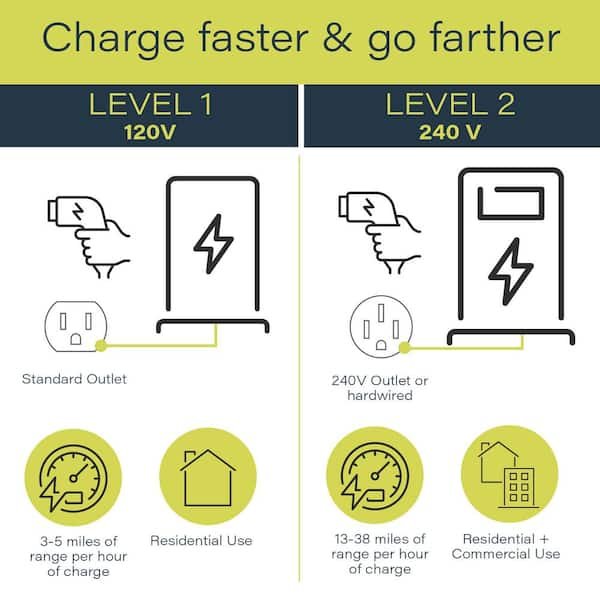
A Level 2 EV charger, ideal for daily home charging to preserve battery health.
Effective Temperature Management
- Park in Moderate Environments: Whenever possible, park your EV in a garage or shaded area to protect it from extreme heat, especially in hot U.S. climates.
- Utilize Preconditioning: Many EVs offer scheduled departure or preconditioning features. Use these to warm or cool the battery to an optimal temperature before driving or DC fast charging, particularly in very cold or hot weather.
Driving and Software Practices
- Drive Smoothly: Frequent aggressive acceleration and hard braking (even with regenerative braking) put more strain on the battery. A moderate driving style reduces thermal and electrical stress.
- Keep Software Updated: EV manufacturers regularly release software updates that include enhancements to the Battery Management System (BMS), optimizing charging algorithms and thermal control for improved longevity.
FAQ: Your Top Questions About EV Battery Cycle Life Answered
Conclusion: A Sustainable Future on the Road
The narrative that EV batteries have short lifespans is increasingly outdated. With continuous advancements in battery chemistry, sophisticated thermal management systems, and intelligent Battery Management Systems, modern EV batteries are engineered to be highly durable. By understanding EV battery cycle life and diligently implementing mindful charging and driving habits—particularly favoring shallow charge cycles and managing temperature exposure—you can confidently expect your electric vehicle's battery to perform optimally for 10, 15, or even 20 years. This impressive longevity not only provides peace of mind but also significantly enhances the overall sustainability and economic benefits of owning an EV, making it a wise investment for the future of transportation.
