

A Deep Dive into Design, Performance, and Value to Guide Your Next Electric Journey
Key Takeaways: Choosing Your Electric Champion
- Design Philosophy: The Hyundai Ioniq 5 embraces a unique retro-futuristic aesthetic with a spacious, upright cabin, while the Kia EV6 opts for a sleek, sporty, and driver-focused design.
- Driving Dynamics: The Ioniq 5 prioritizes a comfortable, smooth ride ideal for families, whereas the EV6 delivers a more engaging and agile driving experience for enthusiasts.
- Shared Excellence: Both vehicles leverage the advanced E-GMP platform, featuring 800-volt architecture for ultra-fast charging and competitive long-range battery options, including an upgraded 84 kWh pack for 2026.
The electric vehicle (EV) landscape is rapidly evolving, with Hyundai and Kia consistently at the forefront of innovation. Their acclaimed electric crossovers, the Hyundai Ioniq 5 and Kia EV6, are built upon the same sophisticated Electric Global Modular Platform (E-GMP), yet they carve out remarkably distinct identities. For the 2026 model year, these siblings continue to impress, offering a compelling blend of cutting-edge technology, impressive performance, and eye-catching aesthetics that makes choosing between them a truly delightful decision for prospective buyers.
This comprehensive comparison delves into the nuances of these award-winning Korean EVs. We will explore their divergent design philosophies, scrutinize their interior features and comfort, analyze their performance capabilities and charging prowess, and examine their pricing and overall value propositions. Our goal is to equip you with the insights needed to determine which of these exceptional electric twins perfectly aligns with your driving needs and personal preferences.
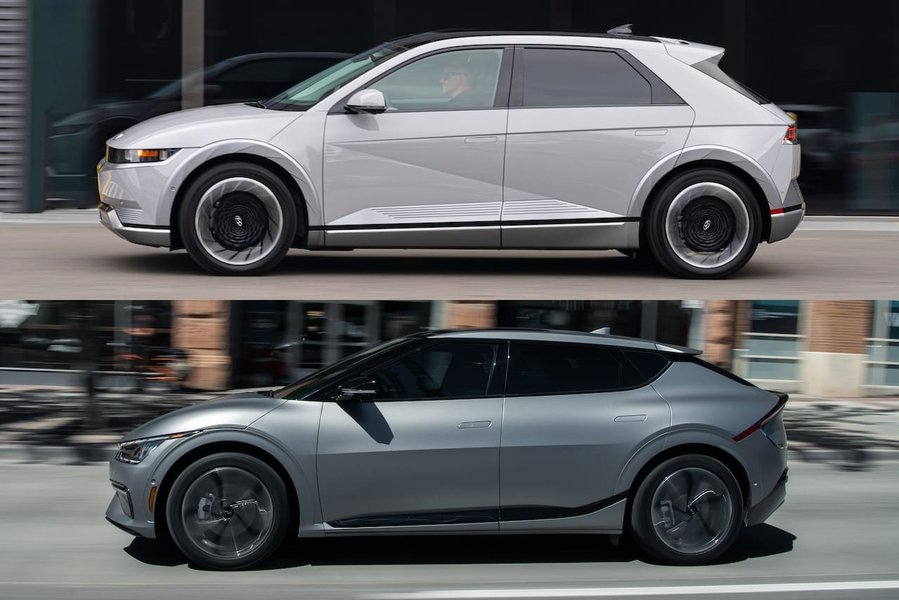
The 2026 Hyundai Ioniq 5 and Kia EV6 showcase distinct personalities despite sharing an advanced electric platform.
Design and Exterior Aesthetics: Retro Charm Meets Sporty Aggression
The most immediate and striking differentiator between the Hyundai Ioniq 5 and the Kia EV6 lies in their exterior design. Despite their shared underpinnings, each vehicle embodies a vastly different visual philosophy, appealing to distinct tastes and priorities.
Hyundai Ioniq 5: A Glimpse into Retro-Futuristic Cool
The 2026 Hyundai Ioniq 5 proudly retains its unique retro-futuristic allure. Its design is characterized by bold, angular lines and distinctive parametric pixel lighting elements, drawing inspiration from Hyundai's iconic Pony hatchback of the 1970s. This aesthetic creates a unique, almost concept-car-like presence that is impossible to ignore on the road. The Ioniq 5's boxier, more upright silhouette isn't just for looks; it significantly enhances interior space, particularly maximizing headroom and providing an expansive, airy cabin feel. It boasts a longer wheelbase of 118.1 inches, further contributing to its spaciousness and stable ride. The Ioniq 5's confident stance and clean lines make it a standout choice for those who appreciate a blend of nostalgic design cues with forward-thinking electric vehicle technology.
Kia EV6: Sleek Dynamics and Aggressive Sportiness
In stark contrast, the 2026 Kia EV6 adopts a sleeker, more aerodynamic, and overtly sporty design language. Its fastback roofline, sharp character lines, and pronounced rear spoiler contribute to a dynamic and performance-oriented appearance. The EV6's lower, wider stance and slightly shorter wheelbase of 114.2 inches give it a more aggressive road presence, indicative of its agile handling and driver-focused nature. Its cab-forward design and distinctive lighting signature, featuring slender daytime running lights that wrap around the front fascia, create a sense of motion even when stationary. The EV6's design speaks to buyers who prioritize a modern, athletic aesthetic and desire a vehicle that conveys dynamism and excitement.
"The Ioniq 5 leans airy and upright, the EV6 leans sporty and cocoon-like. Sit in both if cabin feel is high on your list."
Exterior Lighting and Unique Elements
- Ioniq 5: Features signature pixelated LED arrays for headlamps and taillamps, creating a distinctive digital appearance that enhances its retro-modern theme.
- EV6: Showcases a sleek, sequential rear light bar and wrap-around daytime running lights, contributing to its sophisticated and aggressive profile.

Distinctive rear designs highlight the unique character of the Ioniq 5 (left) and EV6 (right).
Interior Experience: Spacious Sanctuary vs. Driver-Centric Cockpit
The internal environments of the Ioniq 5 and EV6 further emphasize their distinct design philosophies. Both offer modern, tech-rich cabins, but they cater to different priorities regarding comfort, passenger space, and driver engagement.
Ioniq 5: An Open and Versatile Haven
The 2026 Hyundai Ioniq 5 delivers a remarkably open and spacious interior. Its long wheelbase and upright, boxier architecture translate into exceptional rear legroom and generous headroom, making it a particularly comfortable choice for families and rear passengers. The flat floor, characteristic of the E-GMP platform, enhances this sense of openness, allowing for a more versatile and lounge-like cabin experience. The minimalist dashboard features dual 12.3-inch digital displays that appear to float, creating an uncluttered aesthetic. For 2026, the Ioniq 5 includes wireless Apple CarPlay and Android Auto across all trims, alongside practical physical controls for climate settings, a detail often appreciated by drivers. Cargo capacity is substantial, offering 27.2 cubic feet behind the rear seats and expanding to an impressive 59.3 cubic feet with the seats folded. Its wide cargo opening further aids in loading bulky items.
- Interior Highlights:
- Expansive and airy cabin feel, especially for rear passengers.
- Dual 12.3-inch panoramic displays for instrumentation and infotainment.
- Wireless Apple CarPlay and Android Auto are standard features.
- Physical controls for heating and ventilation enhance usability.
- Generous cargo space: 27.2 cu ft (rear seats up), 59.3 cu ft (rear seats folded).
- Available movable center console adds versatility.
EV6: A Sporty and Connected Command Center
The 2026 Kia EV6's interior is designed to wrap around the driver, creating a more intimate and sport-inspired cockpit. Its curved dual panoramic display seamlessly integrates the instrument cluster and infotainment system into a single, sleek unit that sweeps across the dashboard. The center console rises dramatically between the front seats, contributing to a more enclosed, driver-focused environment. While the EV6’s sloping roofline might slightly reduce rear headroom compared to the Ioniq 5, it still offers comfortable seating for most adults, particularly in the supportive front seats. Material quality in both vehicles is comparable, but the EV6's overall atmosphere feels more technical and performance-oriented. The EV6 also includes a North American Charging Standard (NACS) adapter and is expected to integrate a direct NACS port for enhanced charging convenience. Cargo space is competitive at 24.4 cubic feet behind the rear seats and 50.2 cubic feet with them folded, complete with useful features like a reversible cargo floor.
- Interior Highlights:
- Sleek, driver-focused cockpit with a "cocoon-like" feel.
- Curved dual panoramic display integrates infotainment and instrumentation.
- NACS adapter included, with a direct port expected for future models.
- Available heated first and second-row seats, and a heat pump for cold weather.
- Competitive cargo space: 24.4 cu ft (rear seats up), 50.2 cu ft (rear seats folded).
Performance and Driving Dynamics: Balanced Comfort vs. Engaging Sportiness
Beneath their distinct exteriors, both the Ioniq 5 and EV6 harness the power of the E-GMP platform, offering robust electric powertrains and shared 800-volt architecture. However, their suspension tuning and design priorities result in noticeably different driving experiences.
Ioniq 5: Smooth, Serene, and Balanced
The 2026 Hyundai Ioniq 5 is engineered for a smooth, comfortable, and composed ride, excelling in both urban settings and on long highway journeys. Its longer wheelbase and suspension tuning prioritize occupant comfort over aggressive sportiness, effectively absorbing road imperfections without feeling floaty. The steering is light and precise, making it easy to maneuver in tight spaces and pleasant for daily driving. The Ioniq 5 offers versatile powertrain options, including rear-wheel-drive (RWD) and all-wheel-drive (AWD) configurations. Power outputs range from 168 horsepower (with the standard range 63 kWh battery) to 320 horsepower (with the larger 84 kWh battery and AWD), providing brisk acceleration for all situations. The upcoming Ioniq 5 N variant promises even higher performance for those seeking ultimate thrill.
- Powertrain and Range Highlights:
- Standard Range: 63 kWh battery, approx. 220 miles range, 168 hp (RWD).
- Long Range: 84 kWh battery, up to 319 miles range (RWD), 225 hp (RWD), 320 hp (AWD).
- Focus on ride comfort and effortless daily usability.
EV6: Dynamic, Agile, and Thrilling
The 2026 Kia EV6 is engineered for a more engaging and dynamic driving experience. Its lower center of gravity, sport-tuned suspension, and sharper steering provide better cornering capabilities and a more connected feel to the road. The EV6 feels more like a sports sedan in its driving dynamics compared to the Ioniq 5's crossover character, appealing to drivers who enjoy spirited driving. It offers a broad spectrum of performance, from efficient single-motor RWD setups to blistering dual-motor AWD variants. The top-tier EV6 GT model delivers a staggering 576 horsepower, launching from 0-60 mph in under 3.5 seconds, solidifying its position as a true performance EV contender.
- Powertrain and Range Highlights:
- Light trim: 63 kWh battery, 167 hp (RWD).
- Light Long Range: 84 kWh battery, 225 hp (RWD), up to 319 miles range (EPA-est.).
- Wind and GT-Line: Up to 320 hp (AWD).
- GT model: 576 hp (AWD) for extreme performance.
- Emphasis on responsive handling and a "feelsome" driving experience.
"If a sporty character is your kind of performance, the Kia EV6 2026 has a place in your heart."
Battery, Range, and Charging: Industry-Leading Capabilities
Both the Ioniq 5 and EV6 excel in battery technology, range, and charging speed, largely thanks to their shared E-GMP architecture and advanced 800-volt electrical system. This common foundation ensures that both vehicles offer some of the best charging experiences available in the EV market today.
Battery Capacity and Estimated Range
For the 2026 model year, both the Ioniq 5 and EV6 benefit from an upgraded 84 kWh long-range battery pack, a significant enhancement over previous iterations. This larger capacity directly translates to impressive driving ranges. The 2026 Kia EV6, particularly its RWD Light Long Range, Wind, and GT-Line trims, is expected to offer an EPA-estimated range of up to 319 miles. The Ioniq 5 also provides competitive range figures, with many configurations exceeding 300 miles of EPA-estimated driving distance. Both vehicles also offer heat pumps on their AWD trims, a crucial feature for preserving range efficiency in colder climates by using less battery energy for cabin heating.
- Range Expectations:
- 2026 Kia EV6 (RWD, 84 kWh): Up to 319 miles (EPA-est.).
- 2026 Hyundai Ioniq 5 (RWD, 84 kWh): Competitive range, often exceeding 300 miles.
- Both models offer heat pumps on AWD trims to improve cold-weather efficiency.
Ultra-Fast Charging Prowess
The shared 800-volt architecture is a game-changer for both models, enabling incredibly fast DC charging speeds. When connected to a compatible 350 kW DC fast charger, both the Ioniq 5 and EV6 can replenish their batteries from 10% to 80% in approximately 18-20 minutes under ideal conditions. This rapid charging capability significantly reduces downtime on long journeys, making road trips more feasible and convenient. Furthermore, the Kia EV6's inclusion of a NACS adapter (with a direct port anticipated for 2026 models) enhances charging versatility by providing access to the extensive Tesla Supercharger network, alongside the existing CCS infrastructure.
- Charging Speed:
- 10% to 80% charge in approximately 18-20 minutes at a 350 kW DC fast charger.
- Both utilize an 800V electrical system for cutting-edge charging performance.
- The EV6 gains NACS compatibility, broadening charging network access.
Technology and Features: A Wealth of Innovation
The 2026 iterations of both the Hyundai Ioniq 5 and Kia EV6 are packed with cutting-edge technology designed to enhance safety, convenience, and entertainment. While they share many underlying systems, their presentation and specific feature packaging offer subtle distinctions.
Ioniq 5: Intuitive and User-Friendly Tech
The Hyundai Ioniq 5 boasts the latest iteration of Hyundai's infotainment system, known for its crisp graphics, intuitive interface, and responsive operation. For 2026, wireless Apple CarPlay and Android Auto are standard, simplifying smartphone integration. Key features include an augmented reality navigation system, Hyundai Digital Key for smartphone-as-key functionality, and advanced driver-assistance systems like Highway Driving Assist II, which offers semi-autonomous capabilities on compatible roads. Remote Smart Parking Assist and a Blind-Spot View Monitor further enhance convenience and safety, making parking and lane changes less stressful.
- Tech Highlights:
- Dual 12.3-inch infotainment and instrument cluster displays.
- Standard wireless Apple CarPlay and Android Auto.
- Augmented reality navigation system.
- Highway Driving Assist II and Remote Smart Parking Assist.
- Vehicle-to-Load (V2L) functionality.
EV6: Advanced and Driver-Focused Technology
The Kia EV6 mirrors much of its sibling's technological prowess but presents it with a more driver-centric approach. Its curved dual panoramic display provides an immersive experience. Kia Connect offers remote features and over-the-air updates, ensuring the vehicle stays current. The EV6 also features advanced driver-assistance systems, including Highway Driving Assist. An available Meridian premium audio system elevates the in-cabin sound experience, appealing to audiophiles. Like the Ioniq 5, the EV6 also includes Vehicle-to-Load (V2L) functionality, allowing the car to act as a mobile power bank for external devices, a highly practical feature for camping or emergencies.
- Tech Highlights:
- Curved dual panoramic display (combining 12.3-inch screens).
- Kia Connect with remote access and OTA updates.
- Advanced Driver Assistance Systems, including Highway Driving Assist.
- Available Meridian premium audio system.
- Vehicle-to-Load (V2L) functionality.
Safety Suite Shared Excellence
Both models come equipped with a comprehensive suite of standard safety features. This includes automatic emergency braking with pedestrian and cyclist detection, lane-keeping assist, adaptive cruise control, blind-spot monitoring, and multiple airbags. The 2026 updates bring refinements to these systems, enhancing their performance and reliability, ensuring a high level of passenger protection and driver assistance.
Practical Considerations: Space, Usability, and Everyday Living
When it comes to daily practicality, the Ioniq 5 and EV6 offer different strengths that stem directly from their design philosophies. Understanding these differences is key to choosing the vehicle that best fits your lifestyle.
Ioniq 5: Prioritizing Passenger Comfort and Versatile Cargo
The Hyundai Ioniq 5's boxier shape translates directly into superior interior spaciousness, particularly for rear passengers. Its generous headroom and expansive legroom make the back seat exceptionally comfortable for adults, even on longer journeys. The flat floor, a benefit of the E-GMP platform, further enhances comfort for passengers seated in the middle. The Ioniq 5's squared-off rear end and wide cargo opening simplify loading and unloading bulky items. It offers 27.2 cubic feet of cargo space behind the rear seats, expanding to 59.3 cubic feet with the rear seats folded down. This makes it an excellent choice for families, those who frequently transport large items, or anyone who values an airy and unconfined cabin feel.
- Key Practical Advantages:
- Best-in-class rear headroom and legroom.
- Easier ingress and egress due to taller ride height.
- More accommodating for bulky cargo with a squarer hatch opening.
- Movable center console for added flexibility.
EV6: Sporty Comfort with Competitive Utility
While the Kia EV6's sloping roofline does result in slightly less rear headroom compared to the Ioniq 5, most adults will still find it perfectly comfortable for typical use. The focus here is on a more "cocoon-like" feel in the front, emphasizing driver engagement. The cargo area, though marginally smaller than the Ioniq 5's, is still highly competitive for its class, offering 24.4 cubic feet behind the rear seats and 50.2 cubic feet with the seats folded. It also includes thoughtful features like a reversible cargo floor, one side of which is waterproof, adding to its utility. Both vehicles provide versatile seating configurations with 60/40 split-folding rear seats to maximize cargo space when needed.
- Key Practical Advantages:
- More supportive and driver-centric front seats.
- Sleeker profile offers better aerodynamics, potentially aiding highway efficiency.
- Reversible, waterproof cargo floor adds versatility.
- Slightly more compact overall footprint for easier parking in urban environments.
Frunk Space: A Modest Addition
Both models offer a front trunk (frunk) for additional storage, though the space is relatively modest in both cases. It's suitable for storing charging cables, a small bag, or other essentials, but not large suitcases. The EV6's frunk is generally slightly larger than the Ioniq 5's, particularly in RWD versions.
Pricing and Value Proposition: Competitive in the EV Segment
The 2026 model year brings updated pricing for both vehicles, positioning them competitively within the rapidly expanding electric crossover market. While the Hyundai Ioniq 5 typically maintains a slight advantage in entry-level pricing, a comparison of similarly equipped models reveals a nuanced value equation.
Hyundai Ioniq 5 Pricing Overview
The 2026 Hyundai Ioniq 5 is expected to start around $42,000 for its entry-level Standard Range model. Long Range variants will begin approximately $47,000, with premium trims and AWD configurations reaching into the mid-$50,000s. The Ioniq 5 has a history of offering strong value, and its base models often represent a very accessible entry point into the long-range EV market. Buyers should also consider potential federal tax incentives (up to $7,500 for eligible vehicles and buyers) and various state/local incentives, which can significantly reduce the effective purchase price.
- Estimated Pricing (2026):
- Standard Range (63 kWh): Starting around $42,000.
- Long Range (84 kWh): Starting around $47,000.
- Premium trims with AWD: Mid-$50,000s.
Kia EV6 Pricing Overview
The 2026 Kia EV6 is anticipated to start around $44,000 for its Light trim. The popular Light Long Range variant will likely begin around $47,700, with Wind and GT-Line models extending into the $50,000s. The high-performance EV6 GT model, with its impressive 576 horsepower, will push pricing into the $60,000s. While the EV6 might have a slightly higher starting price than the Ioniq 5 for some configurations, it often includes more standard features at comparable price points, contributing to its strong value. Like the Ioniq 5, the EV6 is often eligible for federal and local EV incentives, further enhancing its appeal.
- Estimated Pricing (2026):
- Light trim (63 kWh): Starting around $44,000.
- Light Long Range (84 kWh): Starting around $47,700.
- GT-Line and Wind trims: Mid-$50,000s.
- GT model: $60,000s.
Long-Term Ownership Value
Both Hyundai and Kia offer robust warranties for their EV components, including a 10-year/100,000-mile warranty on the battery and EV powertrain in the US. Early data suggests both vehicles maintain strong resale values, reflecting their popularity and advanced technology. Software updates and continued expansion of charging infrastructure will play a significant role in their long-term value.
Which One Should You Choose? Tailoring to Your Priorities
Ultimately, the decision between the 2026 Hyundai Ioniq 5 and the 2026 Kia EV6 comes down to your personal preferences, priorities, and intended use cases. Both are exceptional electric vehicles that leverage a shared, cutting-edge platform, offering impressive range, ultra-fast charging, and advanced technology. The key lies in understanding their distinct personalities and aligning them with your lifestyle.
Choose the Hyundai Ioniq 5 if:
- You prioritize a remarkably spacious, airy, and comfortable interior, especially for rear passengers.
- You prefer a more upright, commanding driving position with excellent visibility.
- The distinctive retro-futuristic design with pixelated lighting elements appeals to your aesthetic sensibilities.
- You value a smooth, compliant, and comfortable ride that excels in urban environments and on long highway journeys.
- Maximum rear seat comfort and generous cargo height for bulky items are important for your family needs.
- You desire an accessible entry price into the long-range EV market.

The 2026 Hyundai Ioniq 5 presents a bold, retro-futuristic face with a focus on spacious comfort.
Choose the Kia EV6 if:
- You are drawn to a sleek, aggressive, and aerodynamic exterior design with a fastback silhouette.
- You prefer a more driver-focused, "cocoon-like" cockpit environment with integrated curved displays.
- You desire a more engaging, agile, and dynamic driving experience with sharper steering and sportier handling.
- Access to the high-performance GT model, offering exhilarating acceleration, is a significant draw.
- You value the broader charging flexibility offered by NACS compatibility (adapter included, direct port expected).
- A slightly lower driving position and a more athletic feel behind the wheel appeal to your preferences.

The 2026 Kia EV6 showcases a sleek and aggressive design, hinting at its sporty driving dynamics.
"For a smoother ride and more stable handling, the Ioniq 5's wheelbase is 3.9 inches longer than on the EV6 (118.1 inches vs. 114.2 inches)."
Actionable Steps to Make Your Decision:
- Test Drive Both Extensively: This is crucial. Drive both vehicles on the same day, if possible, over varied terrain (city, highway, rough pavement) to truly feel their differences in ride, handling, and comfort.
- Assess Interior Space: Pay close attention to rear passenger comfort, especially if you regularly carry adults or children in car seats. Load typical cargo (stroller, groceries, luggage) to assess practical utility.
- Evaluate Your Commute: Consider if your daily driving prioritizes serene comfort (Ioniq 5) or engaging sportiness (EV6).
- Review Feature Bundles: Compare the standard and optional features for your desired trim levels, paying attention to what truly adds value for your needs.
- Consider Charging Ecosystem: While both are excellent, the EV6's NACS inclusion might be a deciding factor for some users who frequent Tesla Superchargers.
FAQ: Your Burning Questions Answered
Conclusion: A Choice of Personality
The 2026 Hyundai Ioniq 5 and Kia EV6 stand as compelling evidence of the advanced engineering prowess shared by their parent company. They perfectly illustrate how a common, robust platform can be leveraged to create two distinct vehicles, each with its own captivating personality and strengths. Whether your preference leans towards the Ioniq 5's invitingly spacious, retro-modern comfort and serene ride, or the EV6's sleek, sporty dynamism and engaging driving experience, you are investing in an award-winning electric vehicle that promises a blend of performance, efficiency, and a truly modern driving adventure.
There is no objectively "better" vehicle here; only the right choice for your unique needs and preferences. By considering their design philosophies, interior layouts, driving dynamics, and technological offerings, you can confidently select the EV twin that resonates most with your individual style and priorities on the road. Both represent the pinnacle of current EV technology and will undoubtedly deliver a satisfying ownership experience.
Recommended Further Exploration
- Affordable EV Showdown: Is the 2026 Nissan Leaf or 2027 Chevrolet Bolt Your Next Ride?
- Unveiling the 2026 Premium EV Showdown: Tesla, Rivian, and Lucid Battle for Supremacy
